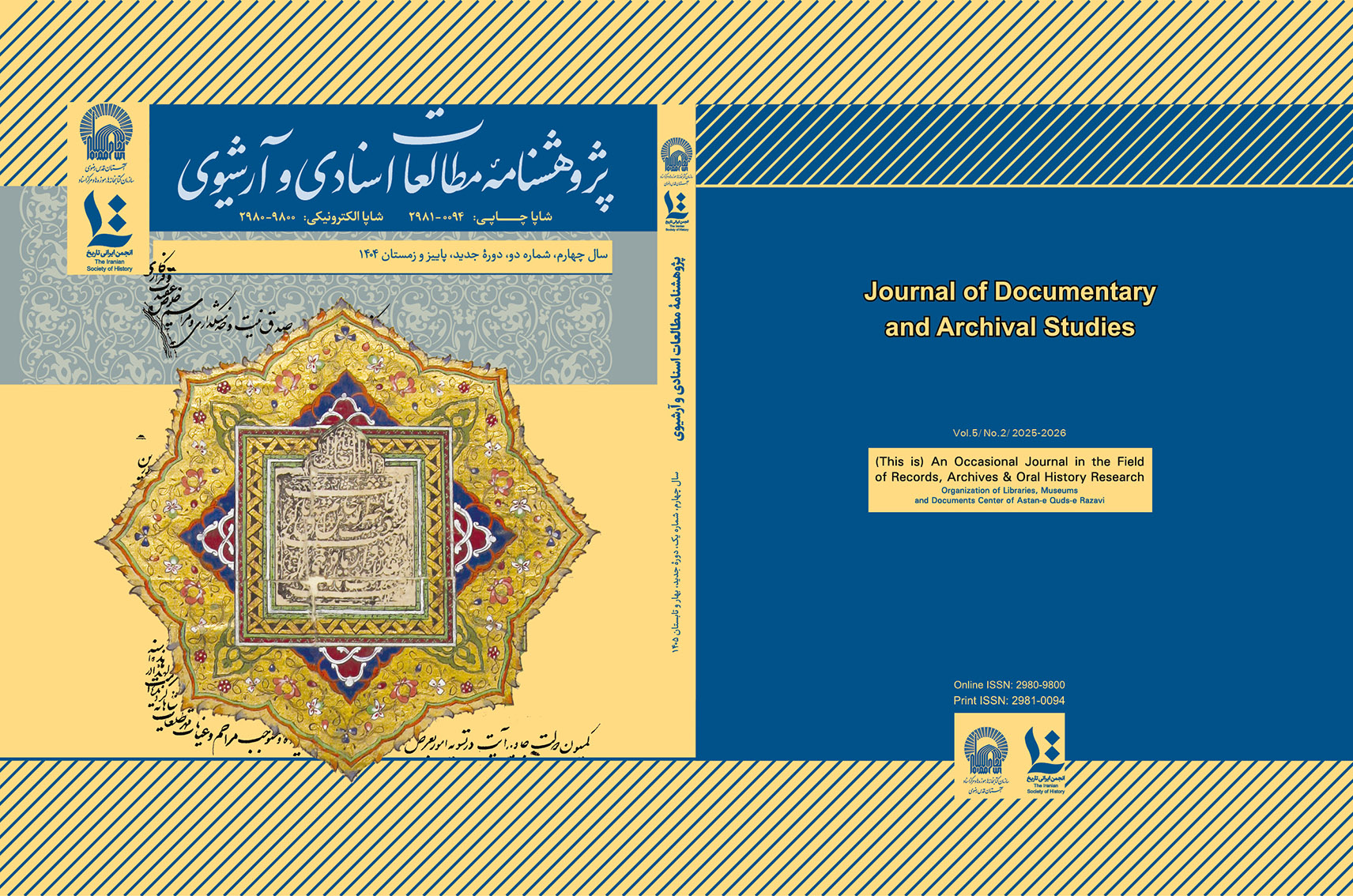
The Journal of Documentary and Archival Studies (JDAS) is a peer-reviewed academic publication dedicated to advancing scholarly inquiry at the intersection of documentation, archival science, recordkeeping, and memory studies. JDAS provides a forum for researchers, archivists, information professionals, and scholars to share original research, theoretical insights, methodological innovations, and critical perspectives on the creation, organization, preservation, and use of documentary heritage in diverse sociocultural and technological contexts. Emphasizing interdisciplinary approaches and global perspectives, the journal welcomes contributions that address both historical foundations and emerging challenges, including digital transformation, ethical stewardship, decolonial practices, and the evolving role of archives in civic discourse and knowledge production.

  Astan Quds Razavi Document Center holds more than 13 million precious pages of documents that date back to hundreds of years, the study of which can be great contribution to the introduction of the history and culture of Islam and Iran. Accordingly, from the onset of this center, endeavors were made to explore, introduce, and publish these documents for the use of the research community. The outcome of these efforts are several books and articles on documents done by The Document Office.

  The four volumes consisted a set of studies conducted by experts of document and press management. The studies were the documents on Astan Quds’ administrative organizations. This unique collection that includes the documents on the history of Iran’s administrative system in Safavid and Afsharid eras is the only survived set of documents in the regard. The series of documents on Qajar, Pahlavi, and the Islamic Revolution periods add to the exclusive value of this collection. It is viewed that this collection will shed light on the historical, economic, and socio-cultural conditions of Iran, especially Khorasan and Mashhad, over the periods in question. Examining these documents will give us valuable data on the administrative organization, the income and payment system, the hierarchy of employees, and different kinds of jobs. Determining the specific features of the documents, their category, and knowing the men and personalities of Astan Quds and Khorasan will add to the documents’ informational values.

 The new series of the journal is a biquarterly journal on written and archival documents that intend to publish the studies on the documents archived in Astan Quds and other archive centers. The journal focuses more on the history of the Great Khorasan, Astan Quds, and Iran. It also aims expanding archival studies based on the experts’ experiences and the drawings of studies on oral history.

**************************************************************** 

About the Journal:

Journal Title: Journal of Documentary and Archival Studies

Country of Publication: Iran, Mashhad.

Publisher: Organization of Libraries, Museums, and Documents Center of Atsan-e Qods Razavi

Scientific Sponsorship Society: Iranian society of History 

Subject Area: Archival Science, Documentary Heritage, Records Management, Digital Archives, Memory Studies, Knowledge Organization

Format: Print and Online

Print    ISSN: 2981-0094

Online ISSN: 2980-9800

Frequency: Semiannual

Publishing Schedule: June, and December

Language: Persian, including English abstracts and bibliographies.

Open Access: Yes, free access to articles

Article types: Research and review papers.

Primary Review: 10 days, approximately.

Peer Review Policy: Double-blind peer-review

Average Refereeing Time: 24 weeks

Acceptance Rate: 20%

Article Processing Charges: No Article Publication Charges (APCs).

Citation Style: The APA citation style

Website: https://docs.aqr-libjournal.ir

Email: psa@library.razavi.ir

Gmail: --  

Tel: +98(0)51-32232511

Address: Office of the Journal of Documentary and Archival Studies, Tabarsi Roundabout, Islamic Research Foundation Building, Documents and Press Affairs ManagementMashhad, Iran.

Indexing & Abstracting:  ISSN-ROAD, Islamic World Science Citation Center (ISC), National Digital Archives of Iranian Scholarly Journals, Noormags, Magiran, Google Scholar, Academia, LinkedIn, etc.

COPE: The Journal of Documentary and Archival Studies (JDAS) follows the policies and guidelines of the Committee on Publication Ethics (COPE) and abides by its Code of Conduct in dealing with potential cases of misconduct.

Copyright: Authors retain unrestricted copyrights and publishing rights.

Type of LicenseCreative Commons Attribution-NonCommercial-NoDerivatives 4.0 (CC BY-NC-ND 4.0).

Required files to upload: Authors must submit the following five essential files through the manuscript submission system: 1. Main Manuscript File (without the author details and prepared based on the provided template. 2. Title Page, 3. Authorship Form (must include the article title, full names of all authors, and be signed by all authors), 4. Conflicts of Interest Form (must be signed by the Corresponding Author and uploaded with the Main Manuscript File), and 5. Cover Letter (Please include any necessary information in the cover letter).

The evolution of financial books in the Iranian bureaucratic system from the fourth century to the late Qajar period

Pages 121-139

https://doi.org/10.30481/psa.2026.252141

Elahe Mahboob

Abstract abstract
One of the key issues in understanding the Iranian administrative system is the study of its financial and monetary institutions throughout the premodern period. This institution, known as the dīvān al-istīfā (the financial administration), underwent significant changes and transformations over time. A detailed examination of dīvān al-istīfā can contribute to a better understanding of Iran’s financial and economic system. Financial records within the Iranian administrative system constitute an important yet understudied area of research. The main research question is: What were these financial records, and how did they change in terms of their number, types, and functions? The aim of this study is to identify these financial records and develop a thematic classification of them from the fourth century AH to the late Qajar period. The research corpus comprises treatises on siyāq, istīfā, and relevant historical documents. This study employs a descriptive-historical approach. The findings indicate that the number of financial records varied over the period under study, the highest number recorded in the fourth century AH and the lowest was in the twelfth century AH and the Afsharid period. In terms of their functions, the financial records can be classified into revenue records, expenditure records, and more limited records. The latter were concerned with recording the revenues and expenditures of the provinces. Some records, however, were also compiled for budget forecasting during the Qajar period. Some of these records, such as the Rūznāmcha and Awārja, existed throughout the periods under study, whereas others were used only during a particular period. Still others were incorporated into other financial records. A thematic analysis of the financial records indicates that the Iranian financial administration (dīvān al-istīfā) followed a systematic process for recording financial calculations.
Extended abstract
Introduction
Within the Iranian administrative system, a variety of administrative correspondence was conducted, reflecting the established practices of governance. The shah’s written orders were implemented through the bureaucratic hierarchy, and the bulk of this correspondence was handled by the dīvāns of inshā and istīfā. Scribal manuals were compiled to provide instruction in the proper composition of such correspondence. The dīvān al-istīfā (the financial administration) also produced documents. preparation and calculation of these documents required specific rules wich were taught by the mustawfīs and muḥarrirān. The types of correspondence in both dīvāns changed over time. Among the most important records of the dīvān al-istīfā were financial records in which the state’s revenues and expenditures were recorded and calculated, forming the basis for the preparation of the state budget. The main focus of this study is to examine the nature and subject matter of these financial records, as well as their changes in terms of number and subject from the fourth century AH to the end of the Qajar period.
Research method
This study employs a descriptive-historical approach. Its research corpus consists primarily of books and treatises written by mustawfīs. Since mustawfīs needed to be well versed in the arts of siyāq and istīfā to compile financial records, they incorporated these principles into their books so that they could serve as instructional resources for other mustawfīs and muḥarrirān. Therefore, these books provide valuable information on the number and subject matter of the financial records and constitute the primary sources for this study. Another group of sources consists of the administrative records of the Astan Quds Razavi that have survived from the Safavid period and provide more detailed information on the structure of the financial records. Examining other types of sources could be pursued in future research.
research findings
The study identified approximately 25 financial records within the Iranian financial administration, dating from the fourth century AH to the late Qajar period. The two types of financial records, Rūznāmcha and Awārja, were used under the same names and for the same purposes throughout all periods. Subsequently, the Tawjīhāt records came into use in the sixth century AH. Other financial records came into use during certain periods, while others were discontinued; some were renamed, whereas others were incorporated into other financial records. The largest number of financial records is found in al-Khwārizmī’s account in Mafātīḥ al-ʿUlūm. However, the exact function of some of the financial records he mentions remains unclear. The fewest financial records are attested for the Afsharid period. Between the seventh and ninth centuries AH, the number of records remained at seven or eight, suggesting that the financial record-keeping system underwent relatively little change during this period. During the Safavid period, five financial records are attested. Sources differ in their accounts of the number of financial records during the Qajar period. According to these accounts, the number ranges from a minimum of three to a maximum of seven financial records. However, this issue requires further investigation. From a thematic perspective, an examination of the financial records indicates that the Iranian financial administration followed a systematic approach to recording financial calculations, as evidenced by the distinct subject categories documented in these records. Initially, financial calculations were recorded on a daily basis. Subsequently, revenues were calculated and recorded in separate financial records (Awārja, Jāmiʿ al-Ḥisāb), while expenditures were recorded in other records (Tawjīhāt, Taḥwīlāt, Muqarrar-i Dīvān). The record-keeping system, however, was not limited to the central dīvān; records were also maintained for the provinces, generally on an annual basis, to document their revenues and expenditures (Mufrada, Juzʾ-i Jamʿ, Muḥāsaba). With regard to the budget record, which was explicitly intended for budget forecasting during the Qajar period, evidence for other periods is less conclusive. In these cases, its use for budget forecasting can only be inferred from the nature and functions of certain financial records, and therefore remains partly conjectural. Given the available sources, further comprehensive research on the financial records is needed to resolve the existing ambiguities.

Sabzevar on the Path to Illumination: A Historical Analysis of the Emergence and Development of the Electricity Industry in Sabzevar during the Pahlavi Era (1928–1979)

Pages 161-183

https://doi.org/10.30481/psa.2026.574399.1116

JALIL Ghassabigazkouh, Mohammad Safaie Bakhsh, Hanieh Tolofakur

Abstract Abstract
The emergence and expansion of the electric power industry, as one of the principal driving forces behind urban modernization, paved the way for the replacement of traditional lighting methods in the city of Sabzevar. The present study employs the historical method and draws upon newly discovered archival documents to examine the process through which the electric power industry was introduced, established, and expanded in the city. The findings indicate that this transformation began in 1928 (1307 SH) through the initiative of Mohammad Sorkhosh-Nia. Subsequently, the efforts of Haj Mohammad Hossein Dowlatabadi and Hossein Ghani in expanding generating capacity and extending the electricity distribution network played a significant role in consolidating and developing the electric power industry. Ultimately, with the establishment of the Sabzevar Regional Electricity Company, scattered individual initiatives were replaced by a centralized and institutionalized system of management. This transformation laid the foundations for the sustainable expansion of the urban electricity network and significantly increased public access to electric power.
Keywords: Sabzevar; Electric Power Industry; Pioneers; Urban Electricity Distribution Network Development; Pahlavi Period.
Introduction
Sabzevar, as one of the strategic centers located along the Silk Road and one of the principal commercial hubs of Khorasan, has long maintained a pioneering position in the adoption of modern technologies. The introduction of electric power into the city represented not merely a technological innovation but also a turning point in the transformation of its social and economic structures, as well as its system of urban administration. Prior to the establishment of the electric power industry, Sabzevar's urban lighting system relied on traditional lighting devices, including kerosene lamps, oil lanterns, and candles, which were fueled by oil and mazut. Even the efforts undertaken by the private sector in 1930 (1309 SH) to import and sell mantle lamps on an installment basis reflected the growing public demand for higher-quality lighting prior to the establishment and expansion of the urban electricity network.
Despite the significance of this technological transition, existing studies on the local history of Sabzevar, including the works of Bayhaqi, Amin, Seyadati, and Motavalli-Haghighi, as well as specialized studies on the electric power industry in Khorasan, particularly those conducted by Soaloni and his colleagues, have largely been limited to scattered references and lack a structural analysis of the relationship between the development of electric power infrastructure and the city's economic and social transformation. Furthermore, most existing accounts date the establishment of Sabzevar's first power plant to the period between 1930 and 1932 (1309–1311 SH). However, evidence published in contemporary newspapers, particularly Azadi during 1927 and 1928 (1306–1307 SH), indicates that the Municipality of Sabzevar had already initiated efforts to replace the traditional oil-based lighting system with electric lighting. These discrepancies between the prevailing historical narrative and documentary evidence form the basis of the present study and underscore the need for a reassessment of the origins and early development of electrification in Sabzevar.
Accordingly, the gap between the prevailing historical narrative and the available documentary evidence gives rise to the central research question of the present study: How did the transition from the traditional lighting system to an urban electric power system in Sabzevar take place, and what role did local actors play in managing and directing this structural transformation during the period from 1928 to 1978 (1307–1357 SH)?
Research Method
The present study employs the historical method and an analytical approach, drawing upon primary sources and newly discovered archival documents. In order to construct a documented account that extends beyond oral narratives, the study utilizes a diverse collection of archival records and specialized repositories covering the period from 1941 to 1977 (1320–1356 SH). The documentary foundation of this research was established through the collection, examination, and analysis of archival materials preserved in the National Library and Archives of Iran, the Sabzevar Municipality Archives, the Sabzevar City Museum, and, in particular, the specialized archives of institutions associated with the electric power sector, including the Sabzevar Electricity Company Archives and the Sabzevar Electric Power and Industries Joint Stock Company. The documentary corpus comprises a wide variety of materials, including official and personal correspondence, the legal statutes of former electricity companies (notably the Dowlatabadi Lighting Company), and financial records, such as electricity bills.
n this study, documentary content analysis has been employed to reconstruct the process through which the management of the electric power industry evolved from a traditional system to an institutionalized form of administration. The identification, collection, and analysis of these newly discovered archival materials extend beyond the presentation of a descriptive account; rather, they seek to address existing gaps in the economic and social historiography of the Pahlavi Period by providing a structural analysis of the relationship between technical infrastructure and transformations in urban governance. Furthermore, the use of documentary evidence drawn from multiple institutions, together with the cross-examination of their records, substantially enhances the credibility of the research findings and provides a well-documented, coherent, and relatively comprehensive account of the emergence and development of the electric power industry in Sabzevar.
Conclusion
The analysis of the development trajectory of the electric power industry in Sabzevar (1928–1979) demonstrates that this process extended beyond a mere technical transformation and reflected a complex transition from traditional structures to modern patterns during the Pahlavi era. The findings of the study explain this transformation at three analytical levels:
First, from an economic perspective, the development of the electric power industry began with a model based on “individual initiative and merchants’ risk-taking.” The transition from the importation of electrical equipment by pioneers such as Mohammad Sorkhosh-Nia and Dowlatabadi to the establishment of the “Sabzevar Electric Power and Industries Joint Stock Company” in 1947 (1326 SH) indicates the maturation of local investment and the shift from scattered individual activities toward the institutionalization of industrial enterprises.
Second, from a social perspective, the process of electrification reflected the class divisions within society. The existence of a dual system of electricity distribution—distinguishing between meter-based consumption for affluent households and flame-based lighting for lower-income groups—indicates that electric power technology was initially adopted primarily by the commercial sector and the more affluent strata of society before gradually extending to other social groups and urban areas.
Finally, from a structural perspective, the development of the electric power industry in Sabzevar resulted from the interaction between private investment and the facilitating role of public institutions, particularly the Municipality and the Governorate. The management of the industry, which initially emerged through the initiative of local merchants and under local administration, gradually shifted toward state control and the concentration of authority within regional institutions in response to expanding national policies and administrative requirements. Overall, the development of the electric power industry in Sabzevar represents a notable example of the process of urban modernization in Iran's second-tier cities, where the combination of entrepreneurial initiatives by development-oriented merchants and the support of administrative institutions laid the foundation for urban infrastructure development and broader urban transformation.

Legal challenges to trade in Bushehr during the Qajar Erea: Evidence from British consular

https://doi.org/10.30481/psa.2026.252043

kobra Mahdinasab, Farhad Rostami ghahfarokhi

Abstract Abstract
This study examines the legal and commercial challenges confronting the port of Bushehr during the final years of the Qajar period, drawing on British consular records from 1911–1913 CE (1290–1292 SH). It focuses on identifying the nature of commercial and legal disputes and examining the role of the British Consulate in addressing and pursuing such claims. Employing a historical-analytical approach, combined with documentary research and qualitative content analysis, the study examines a three-page consular document as a case study. The findings indicate that commercial disputes, financial claims, and customs-related issues, amid the weakness of the Qajar state's judicial and executive institutions, created conditions conducive to consular intervention. In this context, the British Consulate went beyond its conventional administrative and diplomatic functions by pursuing claims and protecting British subjects and commercial interests. The document further demonstrates that consular records were not merely administrative accounts of commercial relations; rather, they reflected asymmetrical power relations and functioned as mechanisms through which Britain exercised economic and legal influence within Bushehr's commercial environment.
Extended abstract
Background and Research Problem
During the Qajar period, the port of Bushehr was one of the most important centers of maritime trade and a major hub connecting Iran to the Persian Gulf and international markets. The expansion of commercial activities in the port, accompanied by the growing presence of foreign merchants and companies, gave rise to a range of legal disputes and challenges concerning commercial transactions, financial claims, customs matters, and merchants’ obligations. Under these circumstances, the weaknesses and inadequacies of the Qajar state’s judicial and executive institutions, together with the extensive presence of foreign diplomatic and consular representatives, particularly those of Britain, led some commercial disputes being pursued outside the regular jurisdiction of Iranian official institutions and pursued through consular intervention. Accordingly, the central problem addressed in this study is to examine the nature of the legal challenges surrounding trade in Bushehr and to elucidate the role of the British consulate in addressing such disputes.
Research Objective
The primary objective of this study is to identify the major legal issues and disputes associated with trade in the port of Bushehr and to analyze the manner in which the British consulate intervened in these disputes. The study also seeks to determine the extent to which consular records can illuminate the legal and commercial relations of Bushehr and reveal the relationship between Iran’s judicial institutions and the interests of British subjects and merchants.
Research Method
This study employs a historical-analytical approach based on documentary research. Its primary data are drawn from British consular records concerning the port of Bushehr for the period 1911–1913 (1290–1292 SH). Among these records, a three-page document was selected as a case study, and its contents were examined using qualitative content analysis. The analysis focuses on the types of disputes, the subjects of contention, the parties involved, the manner in which the consulate pursued the cases, and the relationship between legal issues and British economic and political interests.
Research finding
The findings indicate that a substantial proportion of the issues reflected in the document concerned commercial disputes, financial claims, and customs disagreements. The document demonstrates that the British consulate did not merely act as an administrative intermediary in such cases. Rather, through correspondence, the pursuit of claims, and the protection of British subjects and commercial interests, it intervened in the process of resolving disputes. This situation was associated, on the one hand, with the limited capacity of the Qajar state’s judicial and executive institutions to manage commercial disputes effectively and, on the other, with Britain’s stronger economic and political position in the region.
Accordingly, the legal issues reflected in the document cannot be regarded merely as disputes between individuals or merchants. Rather, these claims and disputes emerged within the broader context of political, economic, and legal relations between Iran and Britain.
Conclusion
The examination of the case study demonstrates that British consular records, in addition to their administrative and legal value, constitute an important source for reconstructing the history of trade and legal relations in the port of Bushehr during the final years of the Qajar period. These records indicate that weaknesses in Iran’s domestic legal and judicial structures, together with the growing influence of foreign powers, created conditions in which consular representatives could play an effective role in commercial disputes and in protecting the interests of their nationals. From this perspective, consular records not only reflect the legal challenges associated with trade in Bushehr but also reveal asymmetrical power relations and the interconnectedness of commerce, law, and political influence in southern Iran during the late Qajar period.

A journey through the arts and crafts of Golpayegan based on documents

https://doi.org/10.30481/psa.2026.558637.1105

Milad Ranjbar, Hassan Ggrishi

Abstract The city of Golpayegan is one of the important cultural and historical cities of Iran. The dozens of cultural and scientific personalities who have emerged from this city and become famous are the reason for this statement. This city, along with its neighbor, Khansar, is one of the pleasant summer villages of Isfahan. In this article, a picture of this city and its handicrafts will be presented by referring to documents. First, a review of documents on the contemporary history of Golpayegan is given, and then it is explored that several industries, including woodcarving, inlay making, and carpet weaving, have grown in this city, and it has even excelled in the field of woodcarving in Isfahan province. Through the documents, government actions and policies in this regard are followed up. Finally, it becomes clear that the Pahlavi government, despite its efforts in marketing these industries, did not pay much attention to education and organizing exhibitions. For this reason, Golpayegan handicrafts, especially woodcarving, faced some problems.

Revisiting and Analyzing Wall Inscriptions in Mashhad in 1978: Examining Their Role in Communicating the Messages of the Islamic Revolution, with an Emphasis on Visual Sources

https://doi.org/10.30481/psa.2026.252140

Saideh Jalalian

Abstract Introduction
During the Islamic Revolution, wall inscriptions rapidly emerged as an important channel for political and social activism. By the second half of 1978, wall inscriptions, taking diverse forms and conveying a range of themes, had become an integral part of the discourse of revolutionary struggle. The primary objective of this study is to examine the various tools used in producing wall inscriptions, the ways in which they were executed in different settings, and the discursive themes reflected in the images, in order to gain insight into the intellectual perspectives of their producers, as well as to investigate the role of wall inscriptions in social networking and the political mobilization of different segments of society during the Islamic Revolution in Mashhad.
Research methodology:
Focusing on images of wall inscriptions in Mashhad collected from reliable archival sources, this study examines the messages of the Islamic Revolution within the urban environment through a qualitative approach and a descriptive-analytical method.
Research findings:
The findings indicate that revolutionaries employed simple and readily available tools to convey their messages. The sites where slogans were inscribed were predominantly the city’s central and heavily trafficked streets, as well as locations where significant events had taken place. The language of the wall inscriptions was clear, accessible, and free from stylistic complexity, addressing broad segments of society. They also played a key role in shaping the discourse of the Revolution and mobilizing public opinion against the Pahlavi regime, contributing significantly to the revolutionary developments during the winter of 1979 and, ultimately, to the victory of the Islamic Revolution.

“The Evolution of the Concept of Evidentiary Authority in Iranian Documents: From Religious Legitimacy to Legal Validity in the Light of Law and Archival Science”

Articles in Press, Accepted Manuscript, Available Online from 14 December 2025

https://doi.org/10.30481/psa.2025.555626.1103

mohammad reza Amirinia

Abstract Abstract

This study examines the historical and institutional evolution of the concept of document validity in Iran, tracing its transition from religious legitimacy and personal trust in traditional notarial practices to legal and technological credibility in modern registration and digital systems. The research argues that document validity in Iran is not solely a legal construct but a product of a long-standing cultural and social continuity of trust that has transformed over time from personal to institutional and, more recently, to technological forms. In early stages, legitimacy derived from the moral and religious authority of scholars and local notaries, while documents embodied ethical and spiritual trust within society. With the administrative reforms of the Qajar era and the centralization of state power, legitimacy shifted toward bureaucratic structures, marking the rise of institutional trust. The 1931 Registration Act consolidated this transformation, making official documents the basis of legal certainty and archives the institutional memory of trust. In the digital age, a new phase—technological trust—has emerged, transferring credibility from human intermediaries to electronic systems. Yet the moral and cultural foundation of trust remains essential. Employing a descriptive–analytical method grounded in historical, jurisprudential, and sociological approaches, this study demonstrates that the evolution of document validity in Iran reflects an enduring link between legitimacy, trust, and institutional memory—one that connects the traditional notarial register to the modern digital platform.
.

The Morphology of Historical Neighborhoods of Mashhad in Qajar Period (Using Colonel Julius Delmage’s Map)

The Morphology of Historical Neighborhoods of Mashhad in Qajar Period (Using Colonel Julius Delmage’s Map)

Volume 2, Issue 1, June 2023, Pages 128-151

https://doi.org/10.30481/psa.2023.422248.1046

vahid tavassoli

Abstract Mashhad is one of the historical cities of Iran, formed based on the existence of a holy place. Several written documents have described Mashhad, but so far, no study can be found that has described the boundaries and structure of its historical neighborhoods. Applying a descriptive-analytical method, this applied research explored a document from Golestan Palace as a case. It tried to answer the question: How was the morphology of Mashhad’s historical neighborhoods in the Qajar period, based on Colonel Julius Delmage’s map? The results showed that the administration system of Mashhad was based on six major neighborhoods. Every neighborhood, based on spatial features and residents, had different structures and different service pilgrimage spaces. All of these have been formed based on their accessibility to the central pilgrimage space of Mashhad and its gates. The formation of most caravanserais in the Paein Khiaban, Sarshour, and Noghan neighborhoods indicates more pilgrimages in them. Moreover, most of urban service spaces and guard places had been located in Sarab neighborhood, indicating that this neighborhood was the resident of the nobles. Eidgah neighborhood is considered the most religious neighborhood of Mashhad as it embraces more mosques and tekyehs, while the central part of the city and Sarab and Noghan neighborhoods are more famous for education.

Nader Shah’s Religious Policy and its Impact on the Management of Astan Quds Razavi Administration in Afsharid Period

Nader Shah’s Religious Policy and its Impact on the Management of Astan Quds Razavi Administration in Afsharid Period

Volume 2, Issue 1, June 2023, Pages 186-204

https://doi.org/10.30481/psa.2024.420330.1043

Ali Suzanchi

Abstract Mashhad as the capital of Afsharid dynasty and holding the holy shrine of Imam Reza, experienced many ups and downs over Afsharid period. All trustees of Astan Quds were of Sadat Razavi and Hosseini families, but their power and authority diminished over time, as the dominant power of the Afsharid dynasty was settled in Mashhad and the kings could control and interfere more easily with different matters of Astan Quds Razavi. Nader Shah and his successors usually made decisions for the trustees on the way of managing Astan Quds, on the way of its cooperation with other organizations and government agents, and on other significant issues. The trustees’ activities and power were limited and the number of employees was reduced in this period. Holding Shias’ specific religious and ritual ceremonies like those common in the Safavid era became more confined. The religious ceremonies of Muslims, especially Eid al-Fitr, Eid al-Adha, and Iranians’ national celebration (i.e., Eid Nowruz) were hold magnificently. Nader Shah specifically emphasized on building and developing religious places, maintained his relationship with Shia scholars and employed them in managing the administrative organization of the Holy Shrine and Jame’ Mosques. This study tried to explore Nader’s religious policies and behavior using the mentioned issues and the survived documents from the period.

An Analysis of the Relationship between Titles and the Function of Seals in Administrative Parts of Astan Quds Razavi in Qajar Era

An Analysis of the Relationship between Titles and the Function of Seals in Administrative Parts of Astan Quds Razavi in Qajar Era

Volume 2, Issue 1, June 2023, Pages 29-51

https://doi.org/10.30481/psa.2023.410044.1034

A Assanabady

Abstract Titles are of the main yet under-researched issues in Qajar era. This study aimed to investigate the titles in Astan Quds Razavi and their relationship with seals in the organization in the Qajar era. Discussing such issues as the history of titles in Iran and Astan Quds Razavi in Qajar era, this study explored the relationship between titles and family seals, personal seals, and jobs and the reasons and ways the titles were produced. This study tried to fill the gap regarding the titles and their relationships with the seals and their functions in administrative parts. The results showed that following the formation and proliferation of some titles in the Qajar era, various titles began to be used in the administrative organizations of Astan Quds Razavi. The survived titles can be categorized into hereditary and non-hereditary under family, personal, and job titles. Titles are issued by the king, custodian and governor of Khorasan and their holders were bestowed, given the requested title, the occupational and financial prestige. Seemingly, there has been a direct relationship between the seal and the titles in Qajar era. Many of the title holders added the title to their seals as a criterion.

Sadr al-Atebba’ and the Legacy of Shamlou Family (Genealogy and Medicine Services)

Sadr al-Atebba’ and the Legacy of Shamlou Family (Genealogy and Medicine Services)

Volume 3, Issue 1, June 2024, Pages 73-86

https://doi.org/10.30481/psa.2025.335708.1069

gholamreza azari khakestar

Abstract The genealogy of old families and examining their social activities indicate that certain professions have been hereditary and continued for many generations, so that the occupations would be considered part of their historical identity. Examining the history of influential families of Mashhad shows that hereditary professions, even artistic or religious ones, continued for several generations in some families associated with the Holy Shrine of Imam Reza (AS). Regarding medicine, some member of old families have been well-known to the people of Mashhad for several generations as physicians. The Shamlu family is considered one of the old families of Mashhad, whose genealogy indicates the presence of physicians for three generations (i.e., from Mirza Gholam Ali Sadr al-Ateba’ to his descendants). This study sought is to explore the history of the Shamlu family and the continuation of the medical profession within this family. Therefore, through examining family documents and oral history, this study dealt with two fundamental questions about the history of this family, medical narratives, and family heritage.

Examining an Endowment Deed of Astan Quds Razavi in the Timurid Era (Endowment Deed of Khajeh Jalal al-Din Ahmad Estarabadi)

Examining an Endowment Deed of Astan Quds Razavi in the Timurid Era (Endowment Deed of Khajeh Jalal al-Din Ahmad Estarabadi)

Volume 2, Issue 1, June 2023, Pages 152-167

https://doi.org/10.30481/psa.2023.418191.1040

reza naqdi

Abstract Among the few endowment deeds of Astan Quds Razavi survived from the Timurid period is a copy of endowment deed belong to Khajeh Jalal al-Din Ahmad Estarabadi. According to the document that has been recorded in a literary-historical collection of the nine and early 10th century (AH), the holder endowed a Tekyeh and a Bath in Estarabad to the lightening of Holy Shrine of Imam Reza (as) and helping the poor Muslims. The results showed that the endower and the trustees was among the Shiite authorities and Sadats of Estarabad in the Timurid and early Safavid periods. Moreover, the results showed that Estarabad was one of the most significant Shiite centers in the period, and some prominent scholars of the region served in the Holy Shrine of Imam Reza (as). The properties specified by the endowment have become part of the neighborhoods of Estarabad following the expansion of this city in later periods. Moreover, due to the expansion of the Holy Shrine and the increase of pilgrims, an increasing need of the Holy Shrine has been providing lighting and supporting pilgrims.

Exploring Merchants’ Investment on Aqueducts and their Challenges in Mashhad in Qajar and Pahlavi Periods

Exploring Merchants’ Investment on Aqueducts and their Challenges in Mashhad in Qajar and Pahlavi Periods

Volume 2, Issue 1, June 2023, Pages 88-109

https://doi.org/10.30481/psa.2023.418317.1041

ali najafzadeh

Abstract Mashhad gained the interest of Merchants of other cities in Qajar period due to its geographical and economic status. Some of the merchants greatly impacted the investment in this city. Some of the merchants tended to holding lands and aqueducts despite their business as a merchant. Moreover, some of them invested in urban aqueducts. This research sought to explore the causes and challenges of Merchants in investing in the aqueducts of Mashhad, and also to see who invested, when and in what aqueducts they invested. The results showed that due to the economic value of water in Mashhad, merchants invested in urban aqueducts from the late Qajar period. Haj Abd al-Rahim Saraf, Mashhadi Abdollah Tajerbashi, Ali Darrodi, Haji Agha Nabavian, and Haji Mahmoud Herati were the most prominent investors who invested in such urban aqueducts as Golkhatmi, Ab-Mirza, Goharshad Mosque, Salsabil, Ab-Manba’, and Darwish Beig. Such issues as drought in Mashhad after 1946, the replacement of deep wells and the need for using clean water decreased the business of holding aqueducts and reduced investment in this field. So, most of the owners sold their shares to Astan Quds Razavi. Taking a descriptive-analytical method, this study relied on the documents of Astan Quds Razavi and Khorasan periodicals.

The Role of Russians in Rahim Khan Chalabianlou’s Initiatives in Azerbaijan Region (1324-1329 AH/1906-1911AD)

The Role of Russians in Rahim Khan Chalabianlou’s Initiatives in Azerbaijan Region (1324-1329 AH/1906-1911AD)

Volume 2, Issue 1, June 2023, Pages 68-87

https://doi.org/10.30481/psa.2023.406573.1031

Mohsen momeni, zienab ahmadvand, leili damirchi

Abstract This research tried to investigate the initiatives and activities of Rahim Khan Chalabianlou, one of the Khans and heads of tribes in Azerbaijan, in misleading the goals of the constitutional revolution and constitutionalists in Azerbaijan area. Moreover, the study delt with the important issue of the role of Russians in fueling the movements. The research hypothesis is that Russians influenced Rahim Khan’s initiatives and movements to mislead the constitutional revolution and to interference in Azerbaijan region. They sometimes overtly showed their cooperation and sometimes they covertly cooperated. Rahim Khan's initiatives like suppressing the revolution of people of Tabriz and making insecure the Azerbaijan region through attacking the telegraph office and cutting the telegraph wires, robbing the postal packages sent from Europe, attacking Ardabil, and conquering the city paved the way for Russia's interference in Iran’s affairs, especially the northern Iran that they assumed their influence area competing with the British government. The study used a descriptive-analytical method and focused on documents and library resources. The results showed that among the initiatives of Rahim Khan were leading Chalabianlou Tribe in attacking Tabriz in the constitutional period, killing Azerbaijani constitutionalists, and making insecure the trading routes of the region. Alongside the attacks, the tsar Russian government supported covertly Rahim Khan’s initiatives and activities. 

Keywords Cloud