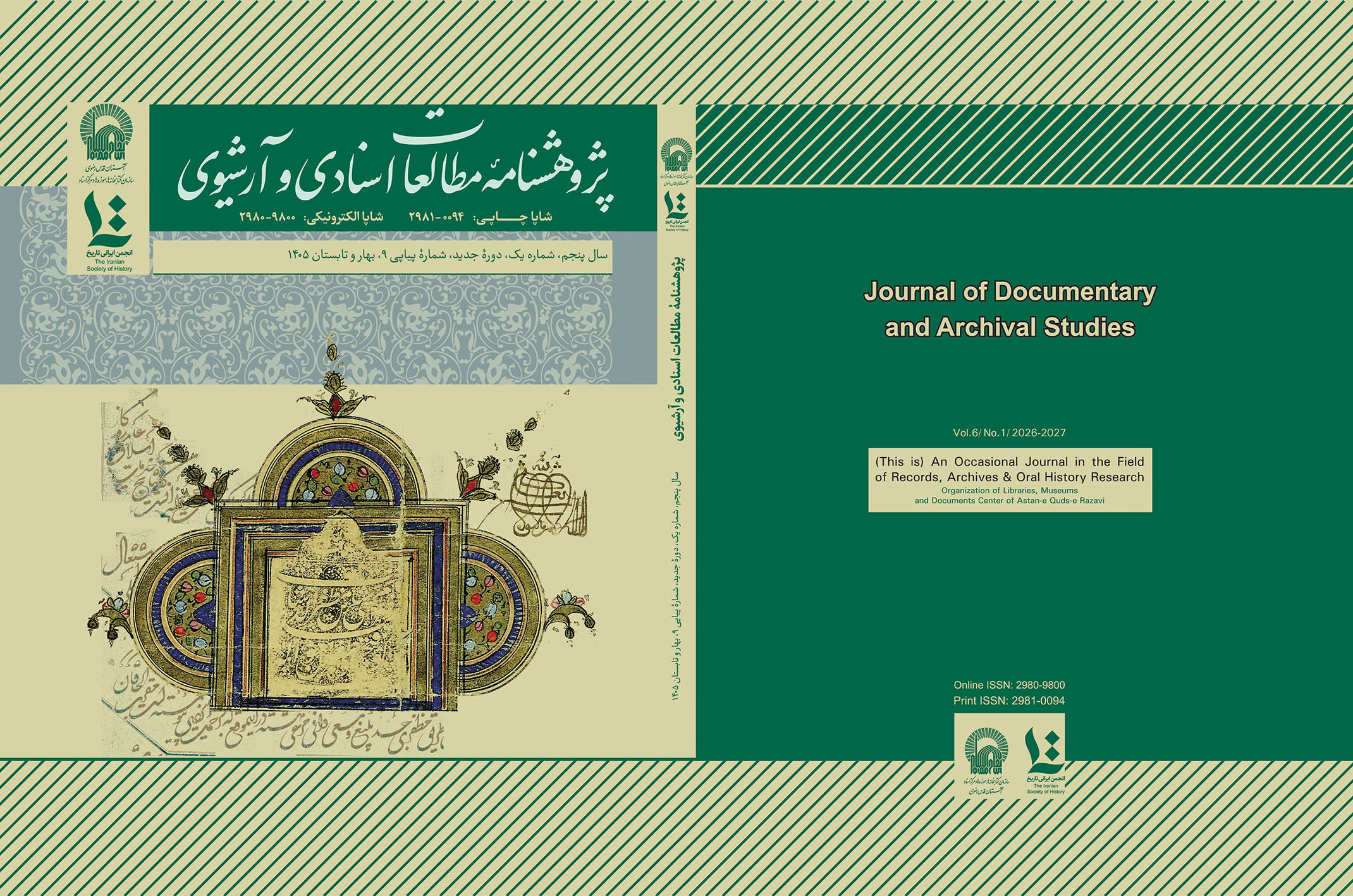
The Journal of Documentary and Archival Studies (JDAS) is a peer-reviewed academic publication dedicated to advancing scholarly inquiry at the intersection of documentation, archival science, recordkeeping, and memory studies. JDAS provides a forum for researchers, archivists, information professionals, and scholars to share original research, theoretical insights, methodological innovations, and critical perspectives on the creation, organization, preservation, and use of documentary heritage in diverse sociocultural and technological contexts. Emphasizing interdisciplinary approaches and global perspectives, the journal welcomes contributions that address both historical foundations and emerging challenges, including digital transformation, ethical stewardship, decolonial practices, and the evolving role of archives in civic discourse and knowledge production.

  Astan Quds Razavi Document Center holds more than 13 million precious pages of documents that date back to hundreds of years, the study of which can be great contribution to the introduction of the history and culture of Islam and Iran. Accordingly, from the onset of this center, endeavors were made to explore, introduce, and publish these documents for the use of the research community. The outcome of these efforts are several books and articles on documents done by The Document Office.

  The four volumes consisted a set of studies conducted by experts of document and press management. The studies were the documents on Astan Quds’ administrative organizations. This unique collection that includes the documents on the history of Iran’s administrative system in Safavid and Afsharid eras is the only survived set of documents in the regard. The series of documents on Qajar, Pahlavi, and the Islamic Revolution periods add to the exclusive value of this collection. It is viewed that this collection will shed light on the historical, economic, and socio-cultural conditions of Iran, especially Khorasan and Mashhad, over the periods in question. Examining these documents will give us valuable data on the administrative organization, the income and payment system, the hierarchy of employees, and different kinds of jobs. Determining the specific features of the documents, their category, and knowing the men and personalities of Astan Quds and Khorasan will add to the documents’ informational values.

 The new series of the journal is a biquarterly journal on written and archival documents that intend to publish the studies on the documents archived in Astan Quds and other archive centers. The journal focuses more on the history of the Great Khorasan, Astan Quds, and Iran. It also aims expanding archival studies based on the experts’ experiences and the drawings of studies on oral history.

**************************************************************** 

About the Journal:

Journal Title: Journal of Documentary and Archival Studies

Country of Publication: Iran, Mashhad.

Publisher: Organization of Libraries, Museums, and Documents Center of Atsan-e Qods Razavi

Scientific Sponsorship Society: Iranian society of History 

Subject Area: Archival Science, Documentary Heritage, Records Management, Digital Archives, Memory Studies, Knowledge Organization

Format: Print and Online

Print    ISSN: 2981-0094

Online ISSN: 2980-9800

Frequency: Semiannual

Publishing Schedule: June, and December

Language: Persian, including English abstracts and bibliographies.

Open Access: Yes, free access to articles

Article types: Research and review papers.

Primary Review: 10 days, approximately.

Peer Review Policy: Double-blind peer-review

Average Refereeing Time: 24 weeks

Acceptance Rate: 20%

Article Processing Charges: No Article Publication Charges (APCs).

Citation Style: The APA citation style

Website: https://docs.aqr-libjournal.ir

Email: psa@library.razavi.ir

Gmail: --  

Tel: +98(0)51-32232511

Address: Office of the Journal of Documentary and Archival Studies, Tabarsi Roundabout, Islamic Research Foundation Building, Documents and Press Affairs Management, Mashhad, Iran.

Indexing & Abstracting:  ISSN-ROAD, Islamic World Science Citation Center (ISC), National Digital Archives of Iranian Scholarly Journals, Noormags, Magiran, Google Scholar, Academia, LinkedIn, etc.

COPE: The Journal of Documentary and Archival Studies (JDAS) follows the policies and guidelines of the Committee on Publication Ethics (COPE) and abides by its Code of Conduct in dealing with potential cases of misconduct.

Copyright: Authors retain unrestricted copyrights and publishing rights.

Type of License: Creative Commons Attribution-NonCommercial-NoDerivatives 4.0 (CC BY-NC-ND 4.0).

Required files to upload: Authors must submit the following five essential files through the manuscript submission system: 1. Main Manuscript File (without the author details and prepared based on the provided template. 2. Title Page, 3. Authorship Form (must include the article title, full names of all authors, and be signed by all authors), 4. Conflicts of Interest Form (must be signed by the Corresponding Author and uploaded with the Main Manuscript File), and 5. Cover Letter (Please include any necessary information in the cover letter).

Studying the structure of the Qajar period's top-level civil offices (1252-1316 AH)

https://doi.org/10.30481/psa.2026.573291.1114

mehdi khanizadeh

Abstract Documents, as one of the most important research sources, are of great importance and value in historical research and are considered to be indicative of the developments of a human society. The aim of this research is to propose new topics regarding the headbook as one of the types of civil records of the Qajar period from two perspectives: external structure and content. The present research method is an analytical archival method that was obtained from examining 15,065 pages of documents available in the Astan Quds Razavi Document Center. The time range of the above documents is 1252-1316 AH. In this research, an attempt has been made to answer the questions of this research by raising the issue of the content and method of organizing these records. The background of the research shows that no independent research has been conducted on headbook so far. The importance of these booklets is that by examining them, useful information can be obtained regarding the civil system of the middle Qajar period. The findings show that the organization of these books had a special order. This book has two chapters of documents and justifications and regulations. The documents chapter is divided into two sections: Abawāb al-Mal and Arbāb al-Tahāwil and Tahāsil. Taxes and other forms are included in the sub-section of Abawāb al-Mal. The tax section included income from the location of the tribes, livestock and provinces. The provinces were included in the sub-section of the states of Azerbaijan, Khorasan, Gilan, Mazandaran, Iraq and Fars. The other forms section included the branches of the provinces and other forms. Arbāb al-Tahāwil and Tahāsil also included the royal treasury receivers and tax collectors. The justifications and regulations chapter included the civil expenses on the basis of which bills were issued. The regulations section also came with three sections: Abawāb al-Mal, Provinces and Miscellaneous, containing copies of the kings' decrees as documentation of expenses.

An Analysis of the Socio-Political Demands of Urmia’s Constitutionalists (With a Focus on the *Faryad* Newspaper)

https://doi.org/10.30481/psa.2026.567211.1113

mohsen momeni, tohid melikzade,

Abstract In the early 20th century, the constitutionalism movement in Iran is a social movement that wanted to establish justice and divide power in Qajar Iranian society. This global movement, which had led to political-social developments in Ottoman and other Asian countries and even in Russia, also created changes in the structure of politics, balance of power and rule of law in Iran. During these changes and developments, due to the lack of unity of popular demands and the resistance of the ruling body to adjust its absolute power, armed tensions to the extent of civil war between the million and the government took place, and dozens of other social-political concepts, besides being general, were repeatedly said and demanded in circles, associations, and publications without defining the executive guarantee.
The current research, with analytical method and approach, seeks to express the demands of Urmia's constitutionalists based on the analysis of the content of Farida newspaper. What changes have these demands seen over time?
The findings of the present research show that the people of Urmia, like other people of Azerbaijan and all over Iran, had big requests such as freedom, freedom, rights and national rights from the very beginning of constitutionalism, and these requests were reflected in Farid Urmia newspaper, but gradually with the weakening of the authority. Government and nomadic uprising, the constitutionalist requests of the people of Urmia have been reduced to the rank of the people's demands and the priority of the requests has been to maintain security.

The Role of Documents, Memoirs, Travelogues, and Oral Sources in Local Historiography in South Khorasan Province (Case Study of Ayatollah Mohammad Hassan Hardengi)

https://doi.org/10.30481/psa.2026.567059.1111

kamal ghouth

Abstract Local history, along with other types of historiography, has been one of the fields that Iranian historians have explored and produced valuable works. This type of historiography, centered on topography, provides valuable insights into the social, economic, cultural, history, geography, rulers and rulers, and political developments of a specific city and region, which is less common in other types of historiography, such as general or dynasties. Today, historical research with a social and civilizational approach to local histories has gained a prominent position, and their reports, along with other sources and texts, are very helpful in depicting the faces of cities and examining the socio-economic and cultural developments of different regions. In the meantime, rereading old documents, accessing existing documents among private custodians of documents, and utilizing existing resources, contribute greatly to the flourishing and dynamism of this knowledge. The province of Qohestan (present-day South Khorasan), despite its harsh climatic conditions and the lack of official historians in the later centuries before the 13th century AH, has been a turbulent and influential region in the political, scientific, and cultural history of the east of the country and even the country at times. In this part of the country, there have been scholars and clerics who may have been left anonymous by local historians. With the help of documentary studies, the existence of reliable documents, and family archives, some of these scholars have been revived and revived. Therefore, this article introduces one of the famous and renowned scholars of Qohestan (whose name was not mentioned in later sources), Ayatollah Mohammad Hassan Hardangi, through documentary and archival studies.

The Political-Ideological Motivations of Mohammad Reza Pahlavi in Financing the Mirrorwork of the Alavid Shrine on the Basis of Newly Discovered Documents (1950-1952)

https://doi.org/10.30481/psa.2026.584802.1121

Mostafa La'l Shateri, Peiman Abolbashari

Abstract The present study examines Mohammad Reza Pahlavi’s objectives in financing the mirrorwork of the shrine of Imam Ali through the use of the assets of Astan Quds Razavi. The research adopts a descriptive-analytical method and is organized on the basis of an unpublished documentary collection entitled “Payment of the Expenses of the Mirrorwork of the Holy Shrine of Hazrat Ali from the Revenues of Astan Quds.” The central question of the article is this: why did a monarch whose lifestyle had distanced itself from religious norms finance the mirrorwork of the sanctuary of Imam Ali from the revenues of Astan Quds? The findings show that, during the period 1950-1952, in terms of the balance of power, this was one of the most difficult phases for the legitimacy and public acceptance of the Second Pahlavi monarchy. The Mosaddeq government and the atmosphere generated by the Oil Nationalization Movement constrained the Shah’s political room for maneuver. In such a context, Mohammad Reza Pahlavi turned, in a symbolic act, to the mirrorwork of the shrine of Imam Ali, seeking thereby to reconstruct his relationship with Shi’ism and to create the conditions for fashioning the image of a Shi’i king in both the national and transnational spheres. In this process, Astan Quds, with its relatively accumulated wealth, distinctive economic structure, and institutional position, whose custodianship was defined in connection with the monarchy, became the institution of choice, and it financed the greater part of the costs associated with this undertaking. Through the channel of a waqf-based institution, the Second Pahlavi sought both to perform an overt act in support of the most sacred Shi’i site and, at the symbolic level, to reconstruct the image of a “Shi’i king.” This decision could also serve as a reminder to the clerical establishment and to the religious strata of public opinion that the most important Shi’i endowment institution occupied an effective place within the network of royal power. the Second Pahlavi aimed to transform an artistic-religious project into an instrument for repairing and reconstructing the image of the monarchy, that is, for producing legitimacy and public acceptance.

The Morphology of Historical Neighborhoods of Mashhad in Qajar Period (Using Colonel Julius Delmage’s Map)

The Morphology of Historical Neighborhoods of Mashhad in Qajar Period (Using Colonel Julius Delmage’s Map)

Volume 2, Issue 1, June 2023, Pages 128-151

https://doi.org/10.30481/psa.2023.422248.1046

vahid tavassoli

Abstract Mashhad is one of the historical cities of Iran, formed based on the existence of a holy place. Several written documents have described Mashhad, but so far, no study can be found that has described the boundaries and structure of its historical neighborhoods. Applying a descriptive-analytical method, this applied research explored a document from Golestan Palace as a case. It tried to answer the question: How was the morphology of Mashhad’s historical neighborhoods in the Qajar period, based on Colonel Julius Delmage’s map? The results showed that the administration system of Mashhad was based on six major neighborhoods. Every neighborhood, based on spatial features and residents, had different structures and different service pilgrimage spaces. All of these have been formed based on their accessibility to the central pilgrimage space of Mashhad and its gates. The formation of most caravanserais in the Paein Khiaban, Sarshour, and Noghan neighborhoods indicates more pilgrimages in them. Moreover, most of urban service spaces and guard places had been located in Sarab neighborhood, indicating that this neighborhood was the resident of the nobles. Eidgah neighborhood is considered the most religious neighborhood of Mashhad as it embraces more mosques and tekyehs, while the central part of the city and Sarab and Noghan neighborhoods are more famous for education.

Nader Shah’s Religious Policy and its Impact on the Management of Astan Quds Razavi Administration in Afsharid Period

Nader Shah’s Religious Policy and its Impact on the Management of Astan Quds Razavi Administration in Afsharid Period

Volume 2, Issue 1, June 2023, Pages 186-204

https://doi.org/10.30481/psa.2024.420330.1043

Ali Suzanchi

Abstract Mashhad as the capital of Afsharid dynasty and holding the holy shrine of Imam Reza, experienced many ups and downs over Afsharid period. All trustees of Astan Quds were of Sadat Razavi and Hosseini families, but their power and authority diminished over time, as the dominant power of the Afsharid dynasty was settled in Mashhad and the kings could control and interfere more easily with different matters of Astan Quds Razavi. Nader Shah and his successors usually made decisions for the trustees on the way of managing Astan Quds, on the way of its cooperation with other organizations and government agents, and on other significant issues. The trustees’ activities and power were limited and the number of employees was reduced in this period. Holding Shias’ specific religious and ritual ceremonies like those common in the Safavid era became more confined. The religious ceremonies of Muslims, especially Eid al-Fitr, Eid al-Adha, and Iranians’ national celebration (i.e., Eid Nowruz) were hold magnificently. Nader Shah specifically emphasized on building and developing religious places, maintained his relationship with Shia scholars and employed them in managing the administrative organization of the Holy Shrine and Jame’ Mosques. This study tried to explore Nader’s religious policies and behavior using the mentioned issues and the survived documents from the period.

An Analysis of the Relationship between Titles and the Function of Seals in Administrative Parts of Astan Quds Razavi in Qajar Era

An Analysis of the Relationship between Titles and the Function of Seals in Administrative Parts of Astan Quds Razavi in Qajar Era

Volume 2, Issue 1, June 2023, Pages 29-51

https://doi.org/10.30481/psa.2023.410044.1034

A Assanabady

Abstract Titles are of the main yet under-researched issues in Qajar era. This study aimed to investigate the titles in Astan Quds Razavi and their relationship with seals in the organization in the Qajar era. Discussing such issues as the history of titles in Iran and Astan Quds Razavi in Qajar era, this study explored the relationship between titles and family seals, personal seals, and jobs and the reasons and ways the titles were produced. This study tried to fill the gap regarding the titles and their relationships with the seals and their functions in administrative parts. The results showed that following the formation and proliferation of some titles in the Qajar era, various titles began to be used in the administrative organizations of Astan Quds Razavi. The survived titles can be categorized into hereditary and non-hereditary under family, personal, and job titles. Titles are issued by the king, custodian and governor of Khorasan and their holders were bestowed, given the requested title, the occupational and financial prestige. Seemingly, there has been a direct relationship between the seal and the titles in Qajar era. Many of the title holders added the title to their seals as a criterion.

Sadr al-Atebba’ and the Legacy of Shamlou Family (Genealogy and Medicine Services)

Sadr al-Atebba’ and the Legacy of Shamlou Family (Genealogy and Medicine Services)

Volume 3, Issue 1, June 2024, Pages 73-86

https://doi.org/10.30481/psa.2025.335708.1069

gholamreza azari khakestar

Abstract The genealogy of old families and examining their social activities indicate that certain professions have been hereditary and continued for many generations, so that the occupations would be considered part of their historical identity. Examining the history of influential families of Mashhad shows that hereditary professions, even artistic or religious ones, continued for several generations in some families associated with the Holy Shrine of Imam Reza (AS). Regarding medicine, some member of old families have been well-known to the people of Mashhad for several generations as physicians. The Shamlu family is considered one of the old families of Mashhad, whose genealogy indicates the presence of physicians for three generations (i.e., from Mirza Gholam Ali Sadr al-Ateba’ to his descendants). This study sought is to explore the history of the Shamlu family and the continuation of the medical profession within this family. Therefore, through examining family documents and oral history, this study dealt with two fundamental questions about the history of this family, medical narratives, and family heritage.

Examining an Endowment Deed of Astan Quds Razavi in the Timurid Era (Endowment Deed of Khajeh Jalal al-Din Ahmad Estarabadi)

Examining an Endowment Deed of Astan Quds Razavi in the Timurid Era (Endowment Deed of Khajeh Jalal al-Din Ahmad Estarabadi)

Volume 2, Issue 1, June 2023, Pages 152-167

https://doi.org/10.30481/psa.2023.418191.1040

reza naqdi

Abstract Among the few endowment deeds of Astan Quds Razavi survived from the Timurid period is a copy of endowment deed belong to Khajeh Jalal al-Din Ahmad Estarabadi. According to the document that has been recorded in a literary-historical collection of the nine and early 10th century (AH), the holder endowed a Tekyeh and a Bath in Estarabad to the lightening of Holy Shrine of Imam Reza (as) and helping the poor Muslims. The results showed that the endower and the trustees was among the Shiite authorities and Sadats of Estarabad in the Timurid and early Safavid periods. Moreover, the results showed that Estarabad was one of the most significant Shiite centers in the period, and some prominent scholars of the region served in the Holy Shrine of Imam Reza (as). The properties specified by the endowment have become part of the neighborhoods of Estarabad following the expansion of this city in later periods. Moreover, due to the expansion of the Holy Shrine and the increase of pilgrims, an increasing need of the Holy Shrine has been providing lighting and supporting pilgrims.

Exploring Merchants’ Investment on Aqueducts and their Challenges in Mashhad in Qajar and Pahlavi Periods

Exploring Merchants’ Investment on Aqueducts and their Challenges in Mashhad in Qajar and Pahlavi Periods

Volume 2, Issue 1, June 2023, Pages 88-109

https://doi.org/10.30481/psa.2023.418317.1041

ali najafzadeh

Abstract Mashhad gained the interest of Merchants of other cities in Qajar period due to its geographical and economic status. Some of the merchants greatly impacted the investment in this city. Some of the merchants tended to holding lands and aqueducts despite their business as a merchant. Moreover, some of them invested in urban aqueducts. This research sought to explore the causes and challenges of Merchants in investing in the aqueducts of Mashhad, and also to see who invested, when and in what aqueducts they invested. The results showed that due to the economic value of water in Mashhad, merchants invested in urban aqueducts from the late Qajar period. Haj Abd al-Rahim Saraf, Mashhadi Abdollah Tajerbashi, Ali Darrodi, Haji Agha Nabavian, and Haji Mahmoud Herati were the most prominent investors who invested in such urban aqueducts as Golkhatmi, Ab-Mirza, Goharshad Mosque, Salsabil, Ab-Manba’, and Darwish Beig. Such issues as drought in Mashhad after 1946, the replacement of deep wells and the need for using clean water decreased the business of holding aqueducts and reduced investment in this field. So, most of the owners sold their shares to Astan Quds Razavi. Taking a descriptive-analytical method, this study relied on the documents of Astan Quds Razavi and Khorasan periodicals.

Exploring the Position of Ghourkhaneh in the Military Structure of Qajar Era

Exploring the Position of Ghourkhaneh in the Military Structure of Qajar Era

Volume 3, Issue 1, June 2024, Pages 38-59

https://doi.org/10.30481/psa.2025.490228.1070

mehdi khanizadeh

Abstract The territorial disputes with neighboring countries and internal insecurities in the Qajar period made it necessary to implement governmental reforms in the army structure. Taking an analytical approach, focusing on archives, and relying on documents of Astan Quds Razavi over 1268-1292 AH, this study tried to examine the organizational structure of the Qajar army. This study intended to see how the organizational structure of the Qajar army was and what the position of arsenal section (Qourkhaneh) was in this structure. Reviewing the related literature showed lack of conducting studies on this issue. The results showed that the Iranian army during this period, despite its inefficiencies, featured with a cohesive system divided into four sections: cavalry, infantry, artillery, and the arsenal. This structure was part of a higher hierarchical structure that embraced Qajar Khans, royal and provincial servant cavalry, military corps (including adjutants and pioneers), soldier corps (including infantry soldiers), and extra-military corps (including small local cavalry and infantry units). In this structure, the arsenal came under the pioneers section and was responsible for fabricating and repairing weapons as well as providing the necessities. The section was composed of the people of two sub-sections: officials and manufacturers, whose salaries and wages were paid through drafts.

Keywords Cloud