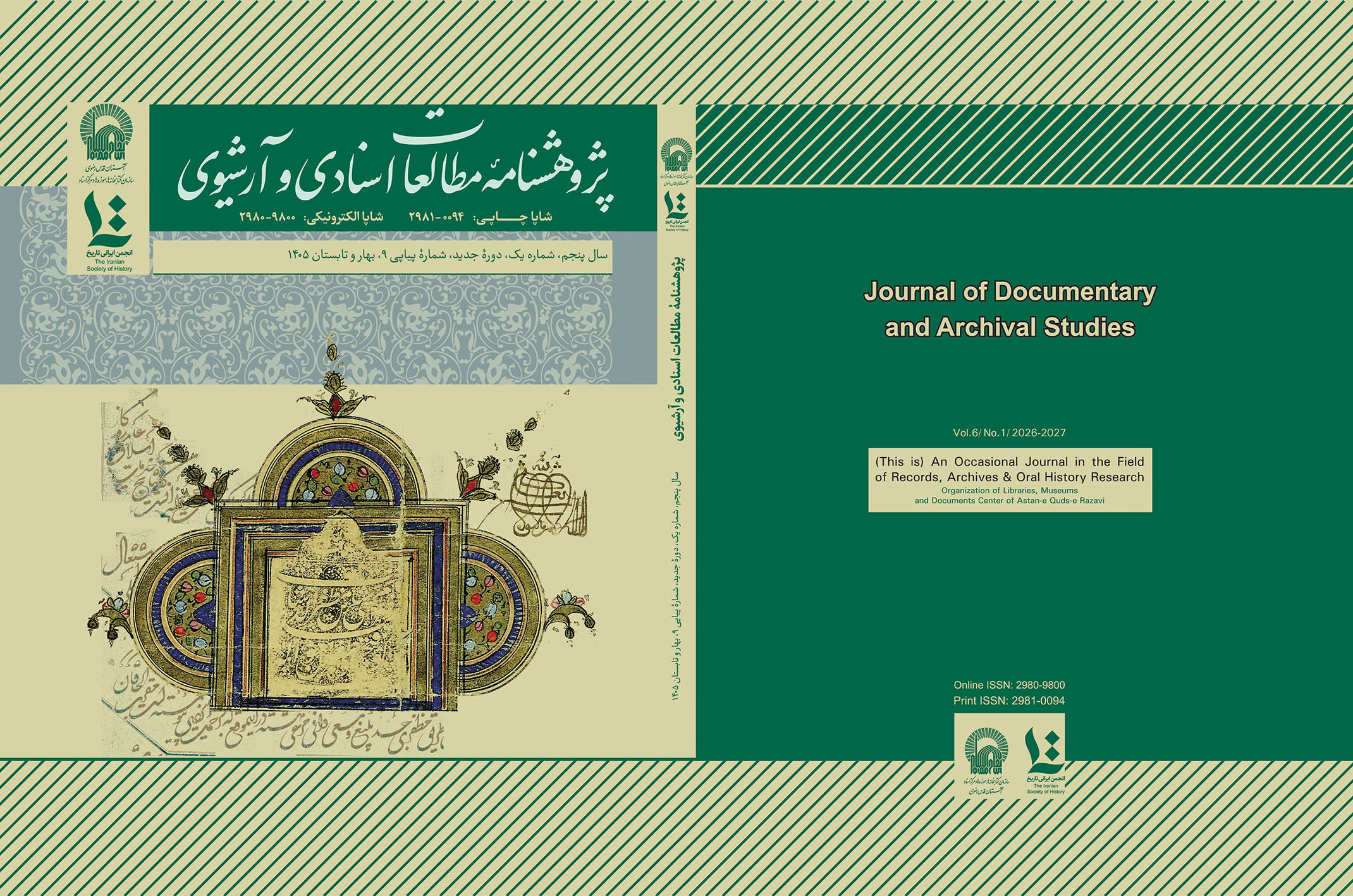
The Journal of Documentary and Archival Studies (JDAS) is a peer-reviewed academic publication dedicated to advancing scholarly inquiry at the intersection of documentation, archival science, recordkeeping, and memory studies. JDAS provides a forum for researchers, archivists, information professionals, and scholars to share original research, theoretical insights, methodological innovations, and critical perspectives on the creation, organization, preservation, and use of documentary heritage in diverse sociocultural and technological contexts. Emphasizing interdisciplinary approaches and global perspectives, the journal welcomes contributions that address both historical foundations and emerging challenges, including digital transformation, ethical stewardship, decolonial practices, and the evolving role of archives in civic discourse and knowledge production.
Astan Quds Razavi Document Center holds more than 13 million precious pages of documents that date back to hundreds of years, the study of which can be great contribution to the introduction of the history and culture of Islam and Iran. Accordingly, from the onset of this center, endeavors were made to explore, introduce, and publish these documents for the use of the research community. The outcome of these efforts are several books and articles on documents done by The Document Office.
The four volumes consisted a set of studies conducted by experts of document and press management. The studies were the documents on Astan Quds’ administrative organizations. This unique collection that includes the documents on the history of Iran’s administrative system in Safavid and Afsharid eras is the only survived set of documents in the regard. The series of documents on Qajar, Pahlavi, and the Islamic Revolution periods add to the exclusive value of this collection. It is viewed that this collection will shed light on the historical, economic, and socio-cultural conditions of Iran, especially Khorasan and Mashhad, over the periods in question. Examining these documents will give us valuable data on the administrative organization, the income and payment system, the hierarchy of employees, and different kinds of jobs. Determining the specific features of the documents, their category, and knowing the men and personalities of Astan Quds and Khorasan will add to the documents’ informational values.
The new series of the journal is a biquarterly journal on written and archival documents that intend to publish the studies on the documents archived in Astan Quds and other archive centers. The journal focuses more on the history of the Great Khorasan, Astan Quds, and Iran. It also aims expanding archival studies based on the experts’ experiences and the drawings of studies on oral history.
****************************************************************
About the Journal:
Journal Title: Journal of Documentary and Archival Studies
Country of Publication: Iran, Mashhad.
Publisher: Organization of Libraries, Museums, and Documents Center of Atsan-e Qods Razavi
Scientific Sponsorship Society: Iranian society of History
Subject Area: Archival Science, Documentary Heritage, Records Management, Digital Archives, Memory Studies, Knowledge Organization
Format: Print and Online
Print ISSN: 2981-0094
Online ISSN: 2980-9800
Frequency: Semiannual
Publishing Schedule: June, and December
Language: Persian, including English abstracts and bibliographies.
Open Access: Yes, free access to articles
Article types: Research and review papers.
Primary Review: 10 days, approximately.
Peer Review Policy: Double-blind peer-review
Average Refereeing Time: 24 weeks
Acceptance Rate: 20%
Article Processing Charges: No Article Publication Charges (APCs).
Citation Style: The APA citation style
Website: https://docs.aqr-libjournal.ir
Email: psa@library.razavi.ir
Gmail: --
Tel: +98(0)51-32232511
Address: Office of the Journal of Documentary and Archival Studies, Tabarsi Roundabout, Islamic Research Foundation Building, Documents and Press Affairs Management, Mashhad, Iran.
Indexing & Abstracting: ISSN-ROAD, Islamic World Science Citation Center (ISC), National Digital Archives of Iranian Scholarly Journals, Noormags, Magiran, Google Scholar, Academia, LinkedIn, etc.
COPE: The Journal of Documentary and Archival Studies (JDAS) follows the policies and guidelines of the Committee on Publication Ethics (COPE) and abides by its Code of Conduct in dealing with potential cases of misconduct.
Copyright: Authors retain unrestricted copyrights and publishing rights.
Type of License: Creative Commons Attribution-NonCommercial-NoDerivatives 4.0 (CC BY-NC-ND 4.0).
Required files to upload: Authors must submit the following five essential files through the manuscript submission system: 1. Main Manuscript File (without the author details and prepared based on the provided template. 2. Title Page, 3. Authorship Form (must include the article title, full names of all authors, and be signed by all authors), 4. Conflicts of Interest Form (must be signed by the Corresponding Author and uploaded with the Main Manuscript File), and 5. Cover Letter (Please include any necessary information in the cover letter).