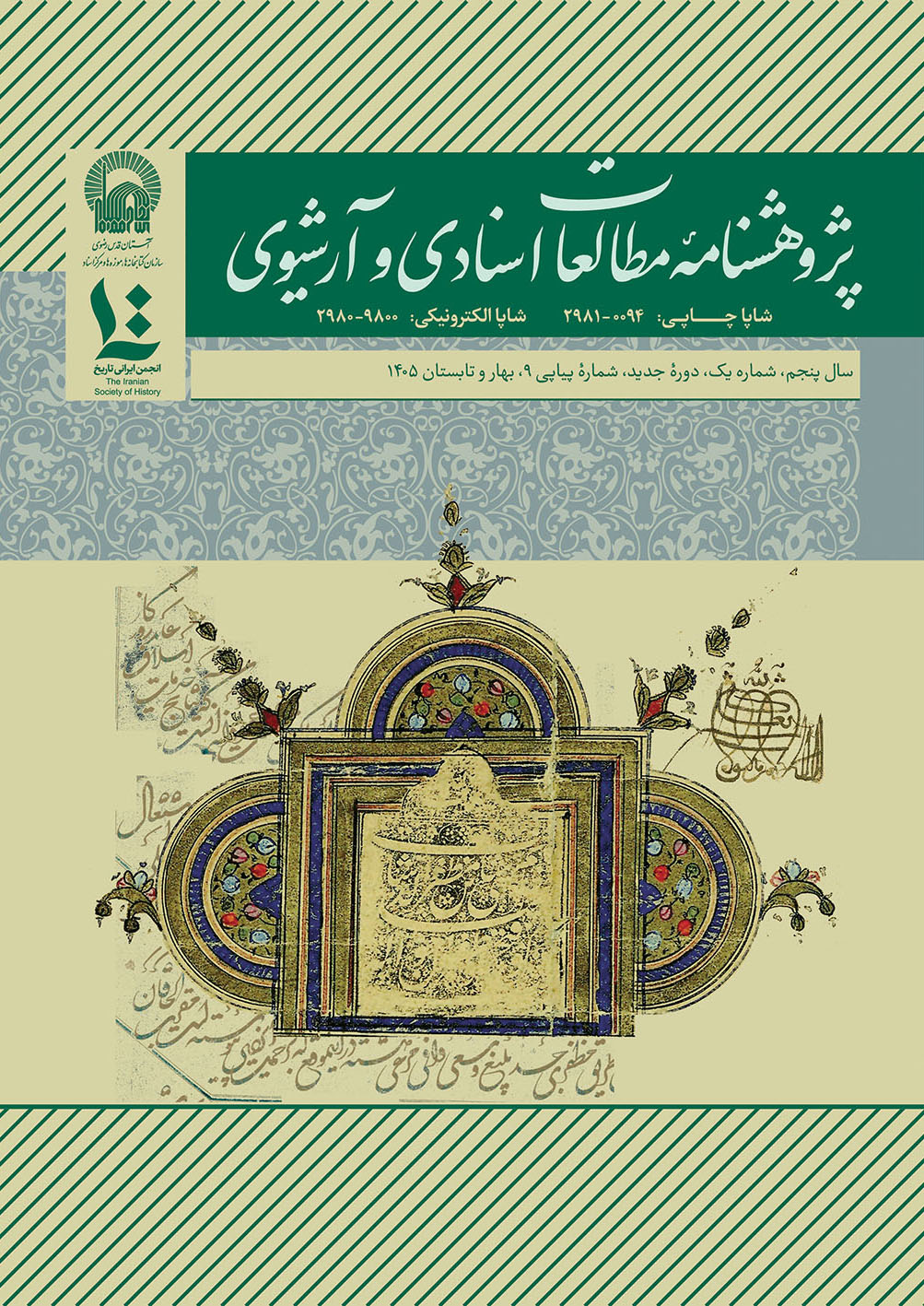
The Journal of Documentary and Archival Studies (JDAS) is a peer-reviewed academic publication dedicated to advancing scholarly inquiry at the intersection of documentation, archival science, recordkeeping, and memory studies. JDAS provides a forum for researchers, archivists, information professionals, and scholars to share original research, theoretical insights, methodological innovations, and critical perspectives on the creation, organization, preservation, and use of documentary heritage in diverse sociocultural and technological contexts. Emphasizing interdisciplinary approaches and global perspectives, the journal welcomes contributions that address both historical foundations and emerging challenges, including digital transformation, ethical stewardship, decolonial practices, and the evolving role of archives in civic discourse and knowledge production.

  Astan Quds Razavi Document Center holds more than 13 million precious pages of documents that date back to hundreds of years, the study of which can be great contribution to the introduction of the history and culture of Islam and Iran. Accordingly, from the onset of this center, endeavors were made to explore, introduce, and publish these documents for the use of the research community. The outcome of these efforts are several books and articles on documents done by The Document Office.

  The four volumes consisted a set of studies conducted by experts of document and press management. The studies were the documents on Astan Quds’ administrative organizations. This unique collection that includes the documents on the history of Iran’s administrative system in Safavid and Afsharid eras is the only survived set of documents in the regard. The series of documents on Qajar, Pahlavi, and the Islamic Revolution periods add to the exclusive value of this collection. It is viewed that this collection will shed light on the historical, economic, and socio-cultural conditions of Iran, especially Khorasan and Mashhad, over the periods in question. Examining these documents will give us valuable data on the administrative organization, the income and payment system, the hierarchy of employees, and different kinds of jobs. Determining the specific features of the documents, their category, and knowing the men and personalities of Astan Quds and Khorasan will add to the documents’ informational values.

 The new series of the journal is a biquarterly journal on written and archival documents that intend to publish the studies on the documents archived in Astan Quds and other archive centers. The journal focuses more on the history of the Great Khorasan, Astan Quds, and Iran. It also aims expanding archival studies based on the experts’ experiences and the drawings of studies on oral history.

**************************************************************** 

About the Journal:

Journal Title: Journal of Documentary and Archival Studies

Country of Publication: Iran, Mashhad.

Publisher: Organization of Libraries, Museums, and Documents Center of Atsan-e Qods Razavi

Scientific Sponsorship Society: Iranian society of History 

Subject Area: Archival Science, Documentary Heritage, Records Management, Digital Archives, Memory Studies, Knowledge Organization

Format: Print and Online

Print    ISSN: 2981-0094

Online ISSN: 2980-9800

Frequency: Semiannual

Publishing Schedule: June, and December

Language: Persian, including English abstracts and bibliographies.

Open Access: Yes, free access to articles

Article types: Research and review papers.

Primary Review: 10 days, approximately.

Peer Review Policy: Double-blind peer-review

Average Refereeing Time: 24 weeks

Acceptance Rate: 20%

Article Processing Charges: No Article Publication Charges (APCs).

Citation Style: The APA citation style

Website: https://docs.aqr-libjournal.ir

Email: psa@library.razavi.ir

Gmail: --  

Tel: +98(0)51-32232511

Address: Office of the Journal of Documentary and Archival Studies, Tabarsi Roundabout, Islamic Research Foundation Building, Documents and Press Affairs ManagementMashhad, Iran.

Indexing & Abstracting:  ISSN-ROAD, Islamic World Science Citation Center (ISC), National Digital Archives of Iranian Scholarly Journals, Noormags, Magiran, Google Scholar, Academia, LinkedIn, etc.

COPE: The Journal of Documentary and Archival Studies (JDAS) follows the policies and guidelines of the Committee on Publication Ethics (COPE) and abides by its Code of Conduct in dealing with potential cases of misconduct.

Copyright: Authors retain unrestricted copyrights and publishing rights.

Type of LicenseCreative Commons Attribution-NonCommercial-NoDerivatives 4.0 (CC BY-NC-ND 4.0).

Required files to upload: Authors must submit the following five essential files through the manuscript submission system: 1. Main Manuscript File (without the author details and prepared based on the provided template. 2. Title Page, 3. Authorship Form (must include the article title, full names of all authors, and be signed by all authors), 4. Conflicts of Interest Form (must be signed by the Corresponding Author and uploaded with the Main Manuscript File), and 5. Cover Letter (Please include any necessary information in the cover letter).

Analysis of the Oldest Structure Map of the Holy Shrine of Imam Reza and the Surrounding Urban Environment (Designed by Zolfaghar Mohandes)

Pages 5-21

https://doi.org/10.30481/psa.2025.485555.1067

vahid tavassoli

Abstract Urban maps can be utilized as significant means for understanding environmental conditions. If these documents are generated following engineering precisions, they can offer a clear depiction of cities to the audience. Moreover, these maps illustrate urban developments all over the history. This applied case study used a descriptive-analytical method to examine one of the oldest maps, depicting the structure of the Holy Shrine of Imam Reza and its surrounding urban environment. The original document is held in Golestan Palace (Tehran, Iran), and an image of the map (registered no. 153990) is held in the Astan Quds Razavi Document Center. The main aim of this study was to analyze this document that has been created by Zolfaghar Mohandes in 1284 AH. He has been trying to find out about the structure of the Holy Shrine of Imam Reza, its physical elements, and the urban environments around the shrine over the Qajar era. The results showed that this document was made in Naser al-Din Shah’s journey to Mashhad. It illustrates the spaces related to the Holy Shrine of Imam Reza, the boundaries of neighborhood, urban service buildings (Timchehs, caravanserais, schools, baths, Ab Anbars (cisterns), Gharavolkhanehs (guardhouses), cemeteries) and the main thoroughfares. Considering the results, one can conclude that this document is the oldest map that illustrates the Holy Shrine of Imam Reza and gives the detailed information for pilgrims. The information is about the access paths to the Holy Shrine, the entrances to the courtyards, shoe repositories, and the way of movement through porches and covered prayer halls to the holy tomb of Imam Reza. Moreover, its illustrates the administrative system and structure of Astan Quds Razavi regarding the service, administrative, educational, security, accommodation, and hospitality sectors for pilgrims. Therefore, this map can be considered the first urban tourism map of Iran on pilgrimage.

A New Discovered Tombstone Inscription from Poushanj Desert of Darab: A Document on the Social Life of this City in the 9th Century AH

Pages 22-37

https://doi.org/10.30481/psa.2025.420975.1065

Emadodin Sheikhhokamaei, Mirza Mohammad Hasani

Abstract This study introduced a newly discovered tombstone inscription from the Poushanj desert cemetery in Darab. The tombstone inscription dates back to the ninth century (877 AH), when Uzun Hasan Aq Qoyunlu rule the region. The deceased man is called Malek Mo’ayyed al-Bazgir. The term “bazgir” may be transformed form of “bazhgir” and “bajgir” that was a bureaucratic job related to tax collection. More likely, this term alludes to the name of “Bazgir Tribe” who lived in western Iran. Historical documents do not show any record of the presence of the people of this tribe in southern Iran. Relying historical sources and documents, this study tried to explore the historical identity of the deceased person in Darab. Considering the title “Malek” before the name of the deceased man, two hypotheses were proposed regarding the reason for this individual’s presence in Darab. The first hypothesis was that after Uzun Hasan’s conquest of Lorestan and defeating Shah Rostam (one of the moluks of “Atabakan Lor-e-Kuchak”), the deceased man as one of the leaders of the Lor rule was sent or exiled to Darab. The second hypothesis was formed based on the occurrences during the reign of another ruler of Lorestan (Shah Hossein), father of Shah Rostam. This ruler was killed in Hamadan in 873 AH over a fight against people of Baharlou tribe. The presence of officials of the Baharlou tribe in Fars during the Qara Qoyunlu period, before the Safavid era, is probable. Accordingly, it is possible that the deceased man had been captured over the fight of the Lor ruler against the Baharlou in Hamadan and sent to Darab. Moreover, this tombstone inscription was explored as a valuable document for determining the approximate date of the end of the socio-political life of Darabjerd city and the beginning of the social life of Darab city. Examining the inscriptions of the tombstone inscriptions, taking a comparative historical method, and relying on library sources, this study tried to identify the historical identity of the deceased man.

Exploring the Position of Ghourkhaneh in the Military Structure of Qajar Era

Pages 38-59

https://doi.org/10.30481/psa.2025.490228.1070

mehdi khanizadeh

Abstract The territorial disputes with neighboring countries and internal insecurities in the Qajar period made it necessary to implement governmental reforms in the army structure. Taking an analytical approach, focusing on archives, and relying on documents of Astan Quds Razavi over 1268-1292 AH, this study tried to examine the organizational structure of the Qajar army. This study intended to see how the organizational structure of the Qajar army was and what the position of arsenal section (Qourkhaneh) was in this structure. Reviewing the related literature showed lack of conducting studies on this issue. The results showed that the Iranian army during this period, despite its inefficiencies, featured with a cohesive system divided into four sections: cavalry, infantry, artillery, and the arsenal. This structure was part of a higher hierarchical structure that embraced Qajar Khans, royal and provincial servant cavalry, military corps (including adjutants and pioneers), soldier corps (including infantry soldiers), and extra-military corps (including small local cavalry and infantry units). In this structure, the arsenal came under the pioneers section and was responsible for fabricating and repairing weapons as well as providing the necessities. The section was composed of the people of two sub-sections: officials and manufacturers, whose salaries and wages were paid through drafts.

The Secondary Applications of the Tea Houses of Isfahan in the 1320s SH

Pages 60-72

https://doi.org/10.30481/psa.2025.496324.1072

Abdolmahdi Rajaei

Abstract Teahouses are considered the major gathering places in Eastern societies. These public places have primary and secondary functions. Their primary function is to serve tea, hookah, and coffee, and their secondary functions have been various over the history. Some time over the history, storytelling and Pardeh Khani (citing out of pictures on curtains) have been prevalent in teahouses. Some other late times, gramophones, radios, and televisions were common to be found in the places. More recently, other things like Wi-Fi has attracted customers. This research tried to see what the secondary functions of Isfahan teahouses were in the 1320s AH. In other words, it sought to see what means have been employed in the teahouses to attract customers. Relying on the documents of the National Archives Organization of Iran and applying a descriptive-analytical method and through library resources, this study found that several secondary or unconventional functions for the teahouses, including theater performances, sports acrobatics, the sale and use of opium, the sale of alcoholic beverages, party activities, and trade union activities. Reviewing previous related studies conducted on teahouses over the last decade, this study tried to contribute to the history of teahouses through examining the newly found documents.

Sadr al-Atebba’ and the Legacy of Shamlou Family (Genealogy and Medicine Services)

Pages 73-86

https://doi.org/10.30481/psa.2025.335708.1069

gholamreza azari khakestar

Abstract The genealogy of old families and examining their social activities indicate that certain professions have been hereditary and continued for many generations, so that the occupations would be considered part of their historical identity. Examining the history of influential families of Mashhad shows that hereditary professions, even artistic or religious ones, continued for several generations in some families associated with the Holy Shrine of Imam Reza (AS). Regarding medicine, some member of old families have been well-known to the people of Mashhad for several generations as physicians. The Shamlu family is considered one of the old families of Mashhad, whose genealogy indicates the presence of physicians for three generations (i.e., from Mirza Gholam Ali Sadr al-Ateba’ to his descendants). This study sought is to explore the history of the Shamlu family and the continuation of the medical profession within this family. Therefore, through examining family documents and oral history, this study dealt with two fundamental questions about the history of this family, medical narratives, and family heritage.

Identification of a Pair of Diamond Earrings inside Atabah Alaviyah’s Shrine based on the Documents of Astan Quds Razavi

Pages 87-95

https://doi.org/10.30481/psa.2025.381975.1017

Seyed Masoud Seyed Bonakdar

Abstract Valuable treasures of the holy shrines of Shia Imams have been formed due to the expression of love and devotion of some rulers and their followers. However, the trajectory of of many of these works has been forgotten due to the passage of time. Retrieving documents related to these works is one of the most basic ways of identifying their histories. The treasure in Alaviyah's tomb holds a collection of the most exquisite works of the Islamic era, but so far, many of its works have not been carefully and scientifically scrutinized and documented. Relying on the documents of the Astan Quds Razavi document collection, this study tried to identify and document a pair of diamond earrings that is considered one of the most exquisite pieces of jewelry found in the treasure of Alaviyah.

The Analysis of Socio-Political Changes of Khorasan Prior to the Constitutional Revolution, using the Documents of British Consulate in Mashhad (1325 AH/1907 AD)

Pages 96-114

https://doi.org/10.30481/psa.2025.498301.1073

Farhad Rostami ghahfarokhi

Abstract This study explored the socio-political changes of Khorasan prior to the Constitutional Revolution, relying on the daily accounts of British Consulate in Mashhad (1325 AH/1907 AD). Over this period, Khorasan was abundant with conflicts between rulers, clergymen, and modernists. At the time, a prominent issue in this regard was the role played by Asef al-Dowleh (Gholamreza Khan Inanlou Shahsavan), the ruler of Khorasan, in selling wheat to Russia, bestowing positions to his own children, and his relations with foreign consulates, especially the British Consulate. Taking a descriptive-analytical method and analyzing the content of the British Consulate’s accounts, this study explored the role of rulers and clergymen in the socio-political tensions of Khorasan. It also explored the conflicts between clergymen and modernists, the impact of consulates on local decisions, and the clergymen’s reaction to reforms. The results indicated that the fundamental issues impacting the changes in Khorasan the period in question were internal conflicts between clergymen and modernists, the influence of consulates in local affairs, and resistance to modernism. The complicated interaction among these groups exerted a strong influence on the socio-political structure of this region, leading to changes in power relations and the local economy.

The Role and Status of Teachers in Astan Quds Razavi Organization according to Historical Documents (A Case Study of Safavid Era)

Pages 115-148

https://doi.org/10.30481/psa.2025.502353.1074

mahboobeh farkhondehzadeh

Abstract Such significant issues as the administrative and financial integrity of Astan Quds Razavi as a divine institution, the creation of hereditary positions like teaching, and the allocation of salaries and duties to the employees of this organization over the Safavid era pose the questions that how teachers and scientists were given the responsibilities in the scientific centers and schools of the holy Shrine, how much, and from what sources they were paid. This study claimed that teachers of the schools and centers of the holy Shrine and its other related centers were appointed and paid by the kings of Safavid dynasty (907-1148 AH). Taking a descriptive-analytical method and relying on archival documents, this study revealed that a man titled “motavallibashi” (custodian) under the supervision of the Safavid kings was appointed to handle the endowments and regulations of Astan Quds Razavi. This way, this institution was organized to have a systematic administrative and civil structure. By Shah Tahmasb Safavi’s order the teachers were appointed and their salaries were paid. Consequently, the position of a teaching came to be one of the official and hereditary positions of Astan Quds Razavi. The surviving documents about the teachers working in this era are mainly financial documents that include information on the salaries, benefits, sources of the salaries, and payment of duties to the descendants. Moreover, the documents include some information on how teachers were appointed and their decrees of appointment were issued.

An Investigation into National Assembly Elections in the Pahlavi Period (Case Study: Guilan)

Pages 149-162

https://doi.org/10.30481/psa.2025.477718.1063

Freydoon Shayeste

Abstract This study tried to see whether the National Assembly Elections of Iran in Pahlavi period (both Reza and Mohammad Reza) were held according to the Constitutional Law. Relying on the documents, memoirs, and other historical sources, this study endeavored to approach the mentioned issue and clearly shows it. Its significance lies in determining if the regime was actually following the constitutional law as it was continuously claiming to be a constitutional monarchy. It can reveal the nature of the two Pahlavi regimes as democratic or autocratic governments. Elections of the 6th to 24th parliaments were held in the Pahlavi era. The main question is that whether the parliamentary elections were based on the Constitutional Law and included the determining role of the public in choosing their own future or the executive power from the beginning had been trying to control the legislative power.

Shiite Symbols in Pilgrimage Scrolls (The Case of Pilgrimage Scroll of Astan Quds Razavi)

Pages 163-200

https://doi.org/10.30481/psa.2025.512607.1078

Susan Nikju, Seyed Mohsen Hoseini

Abstract Focusing on survived documentaries to understand more on religious rituals is a fundamental purpose of understanding religious agency and how they are manifested in society. Pilgrimage is a ritual and mode of worship in Islam, encompassing visits to sacred places and innocent figures. Several objects and symbols that are represented and depicted in the form of sacred images have been produced in diverse dimensions over the centuries. Pilgrimage scrolls can be considered evident examples that can be significant sources for examining the historical trajectory of religions, since they depict several locations, objects, symbols, and religious ceremonies. This study tried to introduce a textual-visual pilgrimage scroll kept in the Library and Documentation Center of Astan Quds Razavi. The results showed that there are some survived scrolls in the centers, libraries, and museums over the glove, and the scroll kept in the Astan Quds Razavi is similar to the Nippur scroll, but can be considered a complete extant visual representation and be complement of each other for analyzing pilgrimage scrolls. The scroll kept in the Astan Quds Razavi deserves to be examined not only at is a pilgrimage scroll but also from a mystical-Sufi perspective. This specific scroll embraces the unique depictions of the Shiite pilgrimage symbols and some part of symbols pertaining to the narrative of the Prophet Muhammad’s ascension (Me’raj). The depicted religious seeker goes through Mecca, visits sacred places, and ultimately arrives at the holy shrine of Imam Reza. He awaits gazing the continuation of the path that only the perfect human being, that is, Prophet Muhammad, has successfully went through and reached the absolute light. This pilgrimage scroll crystalizes the delicate and keen insight of its illustrator as it is featured with the entirety of the pilgrimage in the journey towards the origin of divinity.

Mirdamad is a new student among many students

Articles in Press, Accepted Manuscript, Available Online from 08 March 2025

https://doi.org/10.30481/psa.2025.465660.1061

kazem ostadi

Abstract Mir Damad (died in 1040 AH) was a remarkable scholar of the Safavid period. He was a descendent of the great scholars of Jabal Amel and Mar’ash (Sham, Syria) who had moved to Iran. He wrote several works and trained many prominent pupils. He taught both rational and transmitted sciences for many years in some of the cities he lived (Khorasan, Qazvin, and Isfahan), though many of his pupils remain unknown. Thanks to the correction and publication of many manuscripts in the contemporary time, many of Mir Damad's works has also been scrutinized. So, it is now possible to identify and introduce other pupils of Mir Damad through examining the remained notes, monographs, and annotations of existing manuscripts. This study at first introduced some manuscripts of Mir Damad’s works that are held in the personal library of Sheikh Mohammad Khatoun Ameli (died in 1059 AH) and other libraries. Then, it focused on status of Ibn Khatoun, a scholar contemporary to Mir Damad. This study revealed that seemingly, Sheikh Mohammad Khatoun (leader of the Qutb Shahi government) was Mir Damad’s student.

Eunuchs and Their Social Role in Qajar Era

Articles in Press, Accepted Manuscript, Available Online from 16 March 2025

https://doi.org/10.30481/psa.2025.483849.1066

Marzieh Mortazavi

Abstract In Qajar era, servants were mainly divided into eunuchs (khajehs), slaves (gholams), and handmaidens (kanizes), who were employed for different services. Apart from Iranian eunuchs, who mostly were congenital and sometimes deliberately castrated, most eunuchs of Qajar society were blacks, entered Iran from Africa through the Persian Gulf. This study sought to see the role and social status of eunuchs over the Qajar era. The results indicated that since employing eunuchs was expensive, this group were mostly employed to be in service of the high strata of society such as merchants and princes. They were mainly in the court, doing a variety of domestic and non-domestic activities. It is noteworthy that the eunuchs working in the court held a special status because of their closeness to the top powers. Even, some could gain kings’ attention, and consequently, achieve high positions and change their own social class. Taking a socio-historical approach, this study applied a descriptive-analytical method and relied on library resources and archival documents to answer the related question.

Mashhad in Crisis: Confidential Reports of the British Consulate (1908 CE / 1326 AH(

Articles in Press, Accepted Manuscript, Available Online from 09 December 2025

https://doi.org/10.30481/psa.2025.515630.1079

Farhad Rostami ghahfarokhi

Abstract This article examines the confidential reports of the British Consulate in Mashhad during the year 1908 CE (1326 AH). These documents, authored by Colonel Sykes, the British Consul General in Mashhad, provide valuable insight into the political, social, and economic conditions of Khorasan during the Qajar era. The aim of this study is to analyze the content of these reports in order to understand Britain's role in regional developments, the internal governmental conflicts of Iran, the relationship between rulers and the people and social reactions to the taxation and security policies of that period.
The research methodology is based on a historical-critical analysis of consular documents, comparing the data from the reports with other contemporary historical sources. The findings indicate that the British Consulate was not only an observer of Iran’s internal affairs but also, in some cases, an active player in local crises, including tax disputes, governmental struggles, and social tensions. This article also highlights how internal conflicts and administrative inefficiencies created a context conducive to foreign intervention.

The use of clocks and clockmaking in the Razavi Holy Shrine during the Safavid and Afshari periods

Articles in Press, Accepted Manuscript, Available Online from 09 December 2025

https://doi.org/10.30481/psa.2025.508834.1077

Kobra Sadrian

Abstract At first, humans determined the time of day and night by observing the sun and then by making blue, sundials, and sand clocks. In addition, another means of determining time was playing the flute, which reminded people of sunrise and sunset. With the adoption of Islam by Iranians, sundials were created in mosques to determine the time of prayer and call to prayer. With the arrival of mechanical clocks from the Safavid period, sundials were replaced by mechanical clocks that were repaired and made by foreigners for the king and courtiers. From this time on, clocks were installed in different parts of the shrine of Imam Reza (AS) that were made by Iranians themselves, and this has led to the creation of a profession called clockmaking in the administrative organization of the shrine. The present research, using a descriptive-analytical method and relying on (unpublished) documents of the organization of the Holy Shrine of Razavi, seeks to answer the question of what was the reason for the importance of the use of clocks and the position of clockmakers in the administrative organization of this shrine during the Safavid and Afsharid periods? The results of the present study indicate that the documents of the administrative organization of Astan Quds Razavi, as one of the most important first-hand sources that contain unique information and knowledge about the watchmaking industry in the Razavi Holy Shrine, as one of the first religious places to install mechanical clocks, were important in order to facilitate determining the time and performing the obligatory prayer with the help of Iranian experts familiar with various sciences and industries.

Cultural and religious developments in Neyshabur in the 1950s based on the publication of the Voice of Neyshabur.

Articles in Press, Accepted Manuscript, Available Online from 09 December 2025

https://doi.org/10.30481/psa.2025.540683.1092

peiman abolbashari, Aghdas Sadat Hoseini

Abstract Among the local Iranian press in the contemporary period, less attention has been paid to the analysis of data in the publication Sadehi Neyshabur. The publication began operating in 1952, which coincided with Mossadegh's resignation. Its last issue was published in March 1955. 202 issues have been available in the archives of the Astan Quds Razavi Press and Documents Department for almost 4 years, reflecting the ups and downs of the urban society of Neyshabur. The aim of the present article was to make religious issues and cultural developments in these 4 years the basis of research and to highlight the society's view of solving the aforementioned problems. By emphasizing the cultural and religious conditions, the article has attempted to portray the concerns and possible responses of the elites to help the country overcome the full-scale problems of Iran at that time.nd cultural developments in these 4 years the basis of research and to highlight the society's view of solving the aforementioned problems. By emphasizing the cultural and religious conditions, the article has attempted to portray the concerns and possible responses of the elites to help the country overcome the full-scale problems of Iran at that time.

Jobs related to seals in the administrative documents of Astan Quds Razavi From the Safavid period to the end of the Qajar dynasty

Articles in Press, Accepted Manuscript, Available Online from 09 December 2025

https://doi.org/10.30481/psa.2025.519302.1081

Amene Moosavi

Abstract The breadth of services and current affairs in the administrative organization of the Holy Shrine, which had been formed since the Safavid period, led to the emergence of many jobs in various administrative fields, including jobs such as sealer, engraver or seal maker, and seal seller. The sealer was one of the important civil positions in this organization that was popular until the end of the Qajar period. With the importance of seals, engraving and carving on seals, as well as seal sales, which are among the professions of art and craft, flourished alongside them. However, with the popularity of signatures in the Pahlavi period, the positions of sealer and seal engraver also declined. Therefore, it is important to examine the role of sealer and seal engraver as old and obsolete professions.
The aim of this research is to examine the role and position of jobs related to seals in the administrative system of Astan Quds Razavi in ​​a descriptive-analytical manner with a documentary approach.
By researching these documents, it can be said that although the sealer of the shrine did not have the status and position of the sealer in the court's administrative organization and his duties were more limited, he was considered one of the highest civil service positions and one of the most influential men in the country, so much so that the effect of his seal can be seen on most of the documents of the shrine. Engravers were also artists who, in addition to engraving seals, also engraved vessels, stones, coins, etc.

The creation and evolution of the Filmtech section in the Astan Quds Razavi Library(1969 - 2005)

Articles in Press, Accepted Manuscript, Available Online from 09 December 2025

https://doi.org/10.30481/psa.2025.504117.1075

mostafa farzaneh

Abstract Contrary to the common practice in the world, where microfilm was first considered for commercial-military purposes, in Iran microfilm was used for cultural purposes from the very beginning. The first non-governmental religious institution to take serious measures in this regard by using cultural figures and seeking their opinions was Astan Quds Razavi. The beginning of this goes back to the late 1969s. Advanced and up-to-date equipment was purchased in a short period of time, but there was no solid support for the continuation of microfilming manuscripts, documents, and endowments. This field becames more abandoned the closer to the end of the Pahlavi period. The Islamic Revolution created a turning point in this process by fundamentally changing cultural attitudes. This section, which was dedicated to a limited number of researchers or visiting personalities, provided its services to a very wide range of people after the revolution. Meanwhile, the preparation of microfilms of manuscripts, documents, and endowments was pursued with greater seriousness. From the opening of this department until early 2002, a total of 35 to 40 thousand microfilm rolls were produced. Using interviews, documents, and other research sources, this article attempts to examine the process of creating and changing the microfilm section of the Astan Quds Library.

The Transformation of Iran’s Cultural and Social Life: A Case Study during World War II

Articles in Press, Accepted Manuscript, Available Online from 14 December 2025

https://doi.org/10.30481/psa.2025.555840.1104

hosein rohani sadr, Abdollag Sajedi, nezamali dehnavi

Abstract The cultural and social transformation of Iran during the Second World War (1939–1945) can be regarded as one of the key moments in the country’s transition from tradition to modernity. This study, employing a historical-analytical method and based on documentary and press materials, seeks to answer the following question: How did the Allied presence in Iran lead to a redefinition of the country’s cultural and social structures? The hypothesis of the research posits that although the military occupation of Iran and direct contact with foreign forces constrained the nation’s political sovereignty, it nevertheless generated a structural dynamism within educational institutions, the media, and patterns of urban lifestyle at the social and cultural levels. Analysis of the data indicates that the Second World War provided the conditions for the emergence of a new discourse of cultural modernization and the reconfiguration of social relations—a discourse in which concepts such as literacy, urban order, the role of women in society, and the very notion of “progress” were redefined. Consequently, this period may be viewed as a turning point in the cultural history of Iran, one that accelerated the country’s passage from tradition toward modernity.

Analytical Study of the Signs Issued by Astan Quds in the Timurid Period

Articles in Press, Accepted Manuscript, Available Online from 14 December 2025

https://doi.org/10.30481/psa.2025.541060.1093

Abolfazl Hasanabady

Abstract It is difficult to determine the official administrative history of Astan Quds Razavi. In different historical periods from the Ghaznavids to the present, there has always been a person in charge of managing the affairs of the holy shrine of Imam Reza (AS), who was initially called the Naqib and later the Safavids the Mutawali. This article examines, from the aspect of documentary and documentary research, a sign and a charter issued by the Naqba of the Holy Shrine in the Timurid period. The most important questions of this article are: What are the most important documentary components in the documents under study? What is their informational and content value, and what is the structural difference between the documents issued by the Holy Shrine and the charter issued by Sultan Hussein Bayaqa? The research findings show that the custodians of the Holy Shrine were considered among the scholars and men of honor of this period, and their religious and political status, along with the religious dignity of the shrine of Imam Reza (AS), provided the elements of power that enabled the issuance of a seal and charter to manage the affairs of this religious institution. In addition, the issuance of these documents is evidence that the Timurid kings, in addition to respecting the shrine and sending exquisite gifts and offerings, also granted it an independent administrative identity. A comparative study of the documents also shows that the documentary components of the documents of the Holy Shrine largely correspond to the government charter, and there is only a difference in the tone and content of the issuance of the document.

“The Evolution of the Concept of Evidentiary Authority in Iranian Documents: From Religious Legitimacy to Legal Validity in the Light of Law and Archival Science”

Articles in Press, Accepted Manuscript, Available Online from 14 December 2025

https://doi.org/10.30481/psa.2025.555626.1103

mohammad reza Amirinia

Abstract Abstract

This study examines the historical and institutional evolution of the concept of document validity in Iran, tracing its transition from religious legitimacy and personal trust in traditional notarial practices to legal and technological credibility in modern registration and digital systems. The research argues that document validity in Iran is not solely a legal construct but a product of a long-standing cultural and social continuity of trust that has transformed over time from personal to institutional and, more recently, to technological forms. In early stages, legitimacy derived from the moral and religious authority of scholars and local notaries, while documents embodied ethical and spiritual trust within society. With the administrative reforms of the Qajar era and the centralization of state power, legitimacy shifted toward bureaucratic structures, marking the rise of institutional trust. The 1931 Registration Act consolidated this transformation, making official documents the basis of legal certainty and archives the institutional memory of trust. In the digital age, a new phase—technological trust—has emerged, transferring credibility from human intermediaries to electronic systems. Yet the moral and cultural foundation of trust remains essential. Employing a descriptive–analytical method grounded in historical, jurisprudential, and sociological approaches, this study demonstrates that the evolution of document validity in Iran reflects an enduring link between legitimacy, trust, and institutional memory—one that connects the traditional notarial register to the modern digital platform.
.

The Morphology of Historical Neighborhoods of Mashhad in Qajar Period (Using Colonel Julius Delmage’s Map)

The Morphology of Historical Neighborhoods of Mashhad in Qajar Period (Using Colonel Julius Delmage’s Map)

Volume 2, Issue 1, June 2023, Pages 128-151

https://doi.org/10.30481/psa.2023.422248.1046

vahid tavassoli

Abstract Mashhad is one of the historical cities of Iran, formed based on the existence of a holy place. Several written documents have described Mashhad, but so far, no study can be found that has described the boundaries and structure of its historical neighborhoods. Applying a descriptive-analytical method, this applied research explored a document from Golestan Palace as a case. It tried to answer the question: How was the morphology of Mashhad’s historical neighborhoods in the Qajar period, based on Colonel Julius Delmage’s map? The results showed that the administration system of Mashhad was based on six major neighborhoods. Every neighborhood, based on spatial features and residents, had different structures and different service pilgrimage spaces. All of these have been formed based on their accessibility to the central pilgrimage space of Mashhad and its gates. The formation of most caravanserais in the Paein Khiaban, Sarshour, and Noghan neighborhoods indicates more pilgrimages in them. Moreover, most of urban service spaces and guard places had been located in Sarab neighborhood, indicating that this neighborhood was the resident of the nobles. Eidgah neighborhood is considered the most religious neighborhood of Mashhad as it embraces more mosques and tekyehs, while the central part of the city and Sarab and Noghan neighborhoods are more famous for education.

Sadr al-Atebba’ and the Legacy of Shamlou Family (Genealogy and Medicine Services)

Sadr al-Atebba’ and the Legacy of Shamlou Family (Genealogy and Medicine Services)

Volume 3, Issue 1, June 2024, Pages 73-86

https://doi.org/10.30481/psa.2025.335708.1069

gholamreza azari khakestar

Abstract The genealogy of old families and examining their social activities indicate that certain professions have been hereditary and continued for many generations, so that the occupations would be considered part of their historical identity. Examining the history of influential families of Mashhad shows that hereditary professions, even artistic or religious ones, continued for several generations in some families associated with the Holy Shrine of Imam Reza (AS). Regarding medicine, some member of old families have been well-known to the people of Mashhad for several generations as physicians. The Shamlu family is considered one of the old families of Mashhad, whose genealogy indicates the presence of physicians for three generations (i.e., from Mirza Gholam Ali Sadr al-Ateba’ to his descendants). This study sought is to explore the history of the Shamlu family and the continuation of the medical profession within this family. Therefore, through examining family documents and oral history, this study dealt with two fundamental questions about the history of this family, medical narratives, and family heritage.

Nader Shah’s Religious Policy and its Impact on the Management of Astan Quds Razavi Administration in Afsharid Period

Nader Shah’s Religious Policy and its Impact on the Management of Astan Quds Razavi Administration in Afsharid Period

Volume 2, Issue 1, June 2023, Pages 186-204

https://doi.org/10.30481/psa.2024.420330.1043

Ali Suzanchi

Abstract Mashhad as the capital of Afsharid dynasty and holding the holy shrine of Imam Reza, experienced many ups and downs over Afsharid period. All trustees of Astan Quds were of Sadat Razavi and Hosseini families, but their power and authority diminished over time, as the dominant power of the Afsharid dynasty was settled in Mashhad and the kings could control and interfere more easily with different matters of Astan Quds Razavi. Nader Shah and his successors usually made decisions for the trustees on the way of managing Astan Quds, on the way of its cooperation with other organizations and government agents, and on other significant issues. The trustees’ activities and power were limited and the number of employees was reduced in this period. Holding Shias’ specific religious and ritual ceremonies like those common in the Safavid era became more confined. The religious ceremonies of Muslims, especially Eid al-Fitr, Eid al-Adha, and Iranians’ national celebration (i.e., Eid Nowruz) were hold magnificently. Nader Shah specifically emphasized on building and developing religious places, maintained his relationship with Shia scholars and employed them in managing the administrative organization of the Holy Shrine and Jame’ Mosques. This study tried to explore Nader’s religious policies and behavior using the mentioned issues and the survived documents from the period.

Analysis of the Oldest Structure Map of the Holy Shrine of Imam Reza and the Surrounding Urban Environment (Designed by Zolfaghar Mohandes)

Analysis of the Oldest Structure Map of the Holy Shrine of Imam Reza and the Surrounding Urban Environment (Designed by Zolfaghar Mohandes)

Volume 3, Issue 1, June 2024, Pages 5-21

https://doi.org/10.30481/psa.2025.485555.1067

vahid tavassoli

Abstract Urban maps can be utilized as significant means for understanding environmental conditions. If these documents are generated following engineering precisions, they can offer a clear depiction of cities to the audience. Moreover, these maps illustrate urban developments all over the history. This applied case study used a descriptive-analytical method to examine one of the oldest maps, depicting the structure of the Holy Shrine of Imam Reza and its surrounding urban environment. The original document is held in Golestan Palace (Tehran, Iran), and an image of the map (registered no. 153990) is held in the Astan Quds Razavi Document Center. The main aim of this study was to analyze this document that has been created by Zolfaghar Mohandes in 1284 AH. He has been trying to find out about the structure of the Holy Shrine of Imam Reza, its physical elements, and the urban environments around the shrine over the Qajar era. The results showed that this document was made in Naser al-Din Shah’s journey to Mashhad. It illustrates the spaces related to the Holy Shrine of Imam Reza, the boundaries of neighborhood, urban service buildings (Timchehs, caravanserais, schools, baths, Ab Anbars (cisterns), Gharavolkhanehs (guardhouses), cemeteries) and the main thoroughfares. Considering the results, one can conclude that this document is the oldest map that illustrates the Holy Shrine of Imam Reza and gives the detailed information for pilgrims. The information is about the access paths to the Holy Shrine, the entrances to the courtyards, shoe repositories, and the way of movement through porches and covered prayer halls to the holy tomb of Imam Reza. Moreover, its illustrates the administrative system and structure of Astan Quds Razavi regarding the service, administrative, educational, security, accommodation, and hospitality sectors for pilgrims. Therefore, this map can be considered the first urban tourism map of Iran on pilgrimage.

Astan Quds Razavi and the Reconstruction of Hoveyzeh
(Exploring and Analysis of Reconstruction, using Oral History and Documents)

Astan Quds Razavi and the Reconstruction of Hoveyzeh (Exploring and Analysis of Reconstruction, using Oral History and Documents)

Volume 1, Issue 2, December 2023, Pages 103-124

https://doi.org/10.30481/psa.2023.329965.1008

Alijan sekandari, Gholamreza Azari Khakestar

Abstract Astan Quds Razavi as an endowment organization in line with the goals of Islamic Revolution and emphasizing on Razavi culture and tradition could have an outstanding role in different domains. Participating in the Iran-Iraq war by supporting the frontiers of the war and the presence of its employees in the war are considered important steps in the history and changes of this organization. When Hoveyzeh was taken back in 1982, Astan Guds Razavi proposed and Imam Khomeini ordered the organization to reconstruct it. Considering the facilities, materials and human resources, designing managers tried to design and reconstruct the city according a project timeline. Reconstructing Hoveyzeh in the least possible time and using the best materials and the knowledge of Iranian specialists show undoubtedly Jihadi thought and Islamic management in reconstructing war destructed regions. Investigating different reconstruction steps of Hoveyzeh and the problems it faced, this study sought to answer the questions: Why Astan Quds Razavi started reconstructing Hoveyzeh in the middle of the war? Were the urbanism style, the historical identity, and the urban architecture of the reconstructed city based on the culture of that region? Taking a descriptive-analytical method and using documents on the reconstruction of Hoveyzeh and interviews, the study tried to answer these questions.

Examining the Origin of the Manuscripts of the Endowments of Asadullah Khatoun Ameli (Death: after 1067 AH), Endowed to Astan Quds Razavi

Examining the Origin of the Manuscripts of the Endowments of Asadullah Khatoun Ameli (Death: after 1067 AH), Endowed to Astan Quds Razavi

Volume 2, Issue 2, December 2023, Pages 24-44

https://doi.org/10.30481/psa.2024.422865.1048

kazem ostadi

Abstract Asadullah Khatoun endowed 400 manuscripts to Astan Quds Razavi in 1067 AH. This collection has been the biggest library endowed before the delivery of a collection of more than 700 manuscripts that Nader Shah Afshar in 1145 AH, that he had brought to Iran from the Indian War. This research was done about this library and its endower. That is, to see what information the list of manuscripts of Asadullah Khatoun entails. Another aim of the study was to see what information we can get from the manuscripts about the endower and the origin of his endowed library.  The name of the endower and his lineage, according to the manuscripts, is in these words “the waqef is Asadullah ibn Sheikh Mohammad Mu’min (known as bn Khatoun al-Mashhadi Ameli). Another thing that this study answers is that whether there is a kin relationship to Sheikh Mohammad Khatoun (1059 AH), the leader of the government of Abdullah Qutb Shah in South India and to see if it is possible that these endowed manuscripts belonged to his personal library. The results showed that the 400 copies that have been endowed to Astan Quds Razavi belong to Alami Fahami Sheikh Mohammad bin Khatoun, and the collection has been endowed the library of Astan Quds Razavi by his son. The person has been a leader and vicegerent of Heider Abad kingship for about 20 years of the 46-year period of Shia government of Sultan Abdullah Qutb Shah. Mohammad Khatoun was a pupil of Sheikh Bahaei and Mir Mohammad Mo’men Estrabadi and has established a famous religious school in the south of India.

Exploring the Affectability and Uniting of a Group of Educated Women of Mashhad under the Macro Policies of Reza Shah

Exploring the Affectability and Uniting of a Group of Educated Women of Mashhad under the Macro Policies of Reza Shah

Volume 1, Issue 1, June 2022, Pages 175-194

https://doi.org/10.30481/psa.2022.155360

fateme rezaei makki

Abstract One of the main fields that has got the attention of activists of women's rights after the Constitution was informing women of society and encouraging them to be more active in society. As a result of Reza Shah’s enthronement and his attention to the modernization project, the women whose activities were in line with the program of the ruling government were encouraged. The government even used schools for implementing its cultural program regarding women. This study sought to analyze and explicate the role of girls’ schools of Mashhad in advancing the women's movement. Using documents and newspapers, it tried to answer the question: What role the girls’ schools of Mashhad played in Reza Shah’s government in advancing the women's movement and the presence of women in the social arena? The results show that the schools played a significant role in awareness of women and their presence in society by providing trainings about health, housekeeping, and child caring. Other related activities were lecturing about the benefits of removing hijab, making women familiar with the activities of female students, establishing charity associations for empowering the needy women and children.

Keywords Cloud